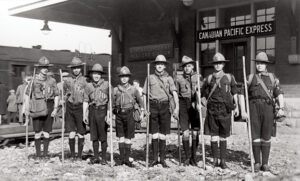
Scouts departing for third UK World Scout Jamboree 1929.--COURTESY Esplanade Arts & Heritage Centre
St. John’s Presbyterian Church can lay claim as host of the first Boy Scout troop in Medicine Hat. Originating in England, the Scout movement quickly spread across the pond. In an age before airmail, radio, television, and the internet, how did the movement get established in Medicine Hat? It began with books.
The founder, Robert Baden-Powell (B-P) was a military man, a specialist in reconnaissance and scouting. To supplement his military wages and to educate his men, he began writing and publishing books.
A Boer War hero, his books sold well in England. Although written as a military manual, his eighth book, Aids to Scouting, became a best seller with youth, much to Lieutenant General Baden-Powell’s surprise.
Consequently, he rewrote the book geared for boys and then with twenty lads, B-P held an experimental boy’s scout camp in 1907. A year later he wrote Scouting for Boys, another best seller upon release. And the Scout movement took off.
In Medicine Hat, an Executive Committee was formed in the autumn of 1910 to form a “battalion” of Boy Scouts. Troop #1 was established at St. John’s with Jessop Nott as Medicine Hat’s first Scoutmaster. Sixty-one boys registered.
In late December, scout uniforms were ordered from Pryce-Jones in Calgary. The uniforms, based on the American old west, included a peaked Stetson hat, khaki shirt and knickers, neckerchief, belt, and a knife at a cost of $5, paid by each boy.
The following spring, some local Scouts attended the first World Scout Jamboree in England to celebrate the coronation of King George V on June 22, 1911. The whole town turned out for their send-off ceremony which included a marching band and keynote speakers at Riverside Park’s grandstand.
Well wishers collected $41 for the departing Scouts. According to the Medicine Hat News, the Scouts honoured were Clare “Cy” Becker, Harlan “Hop” Yuill, his brother John, Horace Whiffen, and Under-Acting Scoutmaster, Ivan Rossiter.
The entire cost of the 3-week trip, paid by their parents, was $230 per boy. The boys were ordinary teens, a train conductor’s son, sons of a local businessman, shopkeepers’ sons. But as adults, they were far from ordinary.
Cy Becker became a provincial aviation pioneer opening northern Alberta up for mail service. Hop Yuill became a local media mogul establishing CHAT-Radio in 1946 and CHAT-TV in 1957.
Horace Whiffen became a skilled attorney and served as a legal advisor with the D.N.D. during WWII. Did their early training as Scouts, allegiance to the Scout Oath and overseas Scout excursion shape their success?
After 1911, more Medicine Hat churches embraced the Scout program. Back in England, B-P’s scouting career was so successful that in 1922, he was awarded a baronet by the British crown and in 1929 a baron, thereafter, known as Lord Baden-Powell.
Sally Sehn is a member of the Historical Society of Medicine Hat & District.