Municipal Matters: Behind the scenes of Medicine Hat’s street sweeping program
By Jami Motz on April 9, 2026.
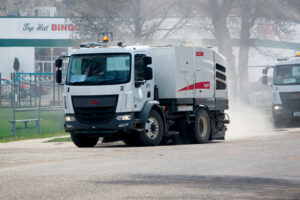
A street sweeper works along Woodman Avenue in the Flats in this handout photo.--PHOTO COURTESY CITY OF MEDICINE HAT
Every spring, before most people have finished their first coffee of the day, our team is already out on the streets of Medicine Hat.
Street sweeping might look straightforward from the sidewalk: a slow-moving vehicle, a steady hum, a quick wave from the cab. Behind the scenes, it is one of the most carefully planned operations we run all year.
Here is how we like to explain it. Take a map of Medicine Hat, put your finger down anywhere, and try to trace every street, both sides, without lifting it, only making right hand turns. Now imagine doing that for the entire city, efficiently, safely, and on a tight schedule.
Our residential sweeping program does not begin in spring. It starts in January. For months, our supervisor, Doug Phillips, maps out routes and fine-tunes schedules, always looking for small efficiencies that make a big difference at scale. Medicine Hat is divided into 17 sweeping zones, and we rotate the order each year so no neighbourhood gets stuck with the same timing season after season.
Once we roll out, the operation runs like clockwork. But Street Sweeping does not happen in isolation; it is a team effort. We coordinate daily with Bylaw, who help ensure streets are clear by ticketing vehicles that have not moved after posted notices. Solid Waste adjusts routes so garbage pickup continues smoothly. Environmental Utilities makes sure we have access to hydrants to keep our water tanks filled. Everyone plays a role in keeping the city moving while we clean it.
Street sweeping has been part of Medicine Hat’s story for nearly a century. The City purchased its first mechanical street sweeper in 1938, a bold move at a time when most cleaning was still done by hand. When a newer machine arrived in 1949, there was public skepticism. Could a machine really replace brooms and elbow grease?
At the time, the City was spending nearly $9,800 a year on hand sweeping labour, a significant investment. It took a few years to prove the value of mechanized sweeping,
but by 1952, hand sweeping was officially phased out of the budget. The results spoke for themselves.
That willingness to adapt and improve is something we still carry forward today. Modern sweepers look very different from their early predecessors. Today’s machines are larger and more powerful, equipped with sensors, controls, and cameras that give operators clear views of the curb, traffic, and their surroundings. In recent years, we have also introduced GIS-based mapping to guide our routes to help us track progress and eliminate overlap. These tools help us work more efficiently and safely, especially on busy streets.
But technology only goes so far. Experience still matters. Steve White, one of our crew leads, sits on the right hand side of the sweeper, surrounded by mirrors, screens, and a constant stream of radio chatter. His job is part driving, part coordination, part vigilance.
Every moment requires focus. Watching traffic, tracking the curb, communicating with the team, and adjusting on the fly are constant demands. It is challenging work, but it is work we take pride in.
And yes, we still make time for what might be the most important job of all. Waving and sounding the horn for kids watching from the sidewalk. Those moments stick with us just as much as the miles we cover.
During peak season, the operation runs in two shifts, early morning to early afternoon, and again into the evening. Our eight-vehicle team includes four street sweepers, two tandem trucks hauling debris, and two half-ton trucks supporting signage and operations. Together, we work methodically, block by block, leaving no stretch of street untouched.
At the end of the day, street sweeping is about more than appearances. Clean streets protect stormwater systems, reduce airborne dust, improve safety for cyclists and drivers, and help extend the life of road surfaces. It is preventative maintenance that saves money over the long term and keeps neighbourhoods healthy.
Most of all, it is about community pride. We live here too. These are our streets, our routes to work, our kids’ school drop-offs, and our evening walks. When we are out sweeping, we are not just maintaining infrastructure. We are taking care of home.
So the next time you see a sweeper roll by, know there is a lot happening behind that slow, steady pass. And give us a wave. We will almost certainly wave back.
Jami Motz is superintendent operations support, municipal works for the City of Medicine Hat
18
-17