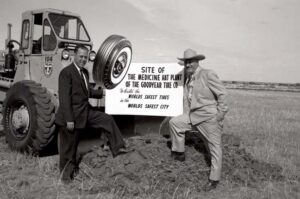
Sod turning with Goodyear Canada President L.E. Spencer and Mayor Harry Veiner in August 1959.--PHOTO COURTESY Esplanade Arts & Heritage Centre
Two milestone events occurred within weeks of each other in the summer of 1959. They were destined to become mutually connected.
It all began when the Goodyear Tire and Rubber Company of Canada Limited decided to expand their operations to Western Canada to produce car, truck, and tractor tires. Several cities were eyed by Goodyear as potential plant sites. Invited by Mayor Harry Veiner, Goodyear representatives visited the city in August 1959. Instrumental in promoting Medicine Hat was the local Goodyear dealer, alderman and deputy mayor John Cockerill. Vital in wooing Goodyear to the city was the local Chamber of Commerce.
Goodyear had two key requirements. Cheap gas and gigantic quantities of cheap water. Cheap gas was a given. Water was a different matter. Goodyear originally considered pumping water from the South Saskatchewan river, a project that would have involved costly cooling equipment. Enter City Engineer, Allan Gunter.
Gunter was aware of a project begun a year earlier by the Alberta Research Council whose Ground Water Division had conducted surveys which suggested that there was a large underground river, or aquifer, half a mile wide, running north-easterly parallel to the existing river.
The surveys included the study of old wells in the area, aerial photographs, seismic refractions, and a geological field study. All supported the hypothesis of a pre-glacial underground river. Council geologists believed that the present-day river crossed over the aquifer near Police Point. Sparked by Goodyear’s interest, test holes were drilled.
On September 5, 1959, theory became reality when the aquifer was tapped at Police Point. The aquifer, 19 feet below ground level was proven to have a capacity of 1.7 million gallons of water/day with a potential of 10 million gallons of water/day.
The cool water temperature varied between 42-52F during the year. Water of this relatively low temperature is ideally suited for industrial cooling. Goodyear was sold! Plant construction now included 18,000 feet of 12-inch concrete asbestos pipe which pumped water to the plant in the newly named Brier Industrial Park.
The 75-acre site, purchased from the CPR included a gas well which fired the boilers to provide steam used in the various phases of tire manufacturing. The CPR also built a spur line along the length of the plant.
The plant was built and brought into production within a record 311 days, at a cost $1,000,000 with $3,500,000 worth of equipment. The contractor was Foundation Co. of Canada Engineering Corporation Ltd. (Fenco). Although the larger sub-trades came from out-of-town, many local businesses benefited, such as the Medicine Hat Brick and Tile Co. Ltd. which supplied the brick for the low-slung building. A United Rubber Workers’ Union (Local #628) was formed, the first in Alberta.
In a 1983 interview with Harry Veiner, the former Mayor proudly revealed that one of his treasured mementos was a letter from Goodyear Canada which indicated that the plant would not have been built in Medicine Hat had it not been for the discovery of the aquifer in the summer of ’59.
Sally Sehn is a past Member of the Heritage Resources Committee, City of Medicine Hat