The Arctic is unlike any other place on Earth. It’s a place where one must adapt or succumb, and it holds a power that conjures strength and resiliency. The Arctic has been the home of the Inuit for 5,000 years. Approximately 65,000 Inuit people live in the four regions of Inuit Nunangat. Most of the communities in Inuit Nunangat can be reached only by air or water, and many have a population of under 500.
The Inuit share their lived experiences through oral histories. Inuit shamans share knowledge and stories to preserve Inuit heritage. Their oral histories explore shamanism, reincarnation, spirituality, mythology, cosmology, anthropomorphism and Sipiniq, the third gender.
Visual manifestations also chronicle Inuit life in the Arctic. Through sculptures, printmaking, drawing and painting, Inuit artists have been documenting life in Northern Canada for over a millennium. The oldest known Paleo-Eskimo portrait dates to 1700 BC.
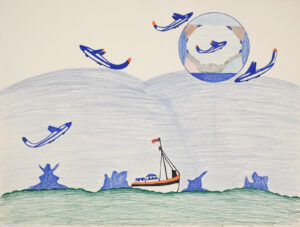
Celebrated Inuit artist Pudlo Pudlat began his artistic career when he moved to Kinngait in the 1950s. There he met James Houston, who taught community members printmaking. In 1960, Pudlo shifted from carving to drawing, printmaking and painting due to an injury.
His touring series Art Is Life is a skillful example of the art of illustrative storytelling.
In her essay “The Emphasis of Storytelling in Illustrations,” Lisk Feng writes, “Traditionally, illustrations are different because of their unique functionality. They used to play a vital role in books, newspapers, Bibles, and children’s books. Nowadays, producing a single image seems to be going in a conceptual direction, namely expounding on ideas. The concept of storytelling is easily understood, yet it is also one of the hardest things to put into a single art piece.”
The magic of Pudlo’s drawings is in how a single illustration embodies a strong narrative. Comparable to 21st-century illustrations, each drawing contains a layered story, with intentional liberations from traditional approaches. They blend reality and surrealism, incorporating aspects such as warped horizons and the absence of depth perception. Planes, birds and boats are reoccurring symbols. With imagery celebrating spring and summer, fishing, hunting, they image is harmonized with soft yellow and pink skies, visually articulating the land of the midnight sun.
Pudlo’s drawings personify the spirit of the north. They cleverly balance the minimalistic and the literal, leaving space to evoke the viewer’s imagination. The style of his drawings is personal, unique but derivative of an aesthetic that has been evolving for a century within the Inuit artistic community.
His works break down barriers. Not long ago, Pudlo’s drawings might have been dismissed, pigeonholed because of folk-art prejudices. His art takes on tough questions: How can a self-taught artist’s work be valid? How can whimsical illustrations created with colored pencil by an Inuit man be compelling to many?
Of course, history has proven that creativity doesn’t need to be taught, that the human lived experience is vast, and that artists document collective moments and memories, communicating through a universal language of visual expression. Pudlo Pudlat’s drawings articulate a visual history of his community, his family and, most importantly, his life in the Arctic.
Art is Life by Pudlo Pudlat is currently on exhibit at the Esplanade until Mar. 7. A drawing workshop in conjunction with this exhibit is taking place on Feb. 28 visit tixx.ca for information and to register.
Xanthe Isbister is director/curator, Galleries and Collections at the Esplanade Arts & Heritage Centre