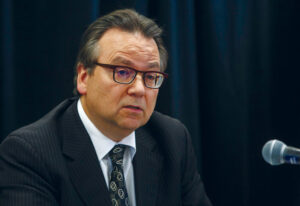
Alberta Auditor General Doug Wylie has released a report that shows numerous inconsistencies with health-care reporting from both the provincial government and AHS.--CP FILE PHOTO
zmason@medicinehatnews.com
A new report by the province’s Auditor General found health-care performance reporting has failed to meet legal standards.
Auditor General Doug Wylie says AHS reporting was “inconsistent” and “not high-quality.”
The report attributes some of this failure to the lack of consistency in the province’s health-care leadership, with the AHS board being dismissed in its entirety twice and several new ministers and associated ministries established since 2022.
The report comes out one day after the passing of Bill 11, legislation enabling dual-practice health care in the province.
The UCP government has said adding more privatized care will ease long waits, but voted down amendments to the bill that would require regular reporting on metrics like surgical wait times.
NDP MLA and Shadow Minister of Hospital and Surgical Health Facilities Sarah Hoffman says the government has consistently argued that Bill 11 will improve wait times. She says their rejection of the amendment was frustrating.
“If this really is about wait times they should feel comfortable tracking it, reporting it, holding themselves accountable for them,” she said.
The government also rejected an amendment that would codify the exclusion of family medicine from dual practice. The government has said in statements that family doctors will not be eligible to practice concurrently in both systems, but the inclusion of that condition in the bill was voted down.
The Auditor General’s report was focused on the 2023 fiscal year, or the period of time stretching Apr. 1, 2022 to Mar. 31, 2023.
Provincial law required AHS, then the primary custodian of public money spent on health care in the province, to publish an annual report, a business plan and a health plan outlining how performance will be measured.
AHS did not publish a business report for the 2023 fiscal year.
Correspondences between the Minister of Health and AHS acknowledged there was a legal requirement to publish the plan, but it was never published.
The following business plan was published 300 days into the fiscal year. Non-mandatory accountability reporting has also declined since 2021.
The report also stated that metrics were chosen selectively, failures to meet benchmarks were not explained and findings were obscured by vague language and a lack of hard data.
Wylie noted variations between the numbers reported publicly and internal numbers from the same time period.
In an example included in the report, the AHS action plan from April 2023 showed EMS response times improving from more than 60 minutes to just 39.6 minutes in remote communities, even though the improvement occurred in only one specific week.
“We traced the EMS numbers to a single week in mid-April, when the wait times for remote EMS temporarily dipped to 39.6 minutes from a consistent weekly average of around 63 minutes,” wrote Wylie.
Wylie also pointed out that reports often lacked definitions, comparisons against targets or benchmarks, or indication of where information originated, making findings difficult to understand.
He also stated that when he asked for records that could support the reporting and its contents, they found that no records were available.
In November 2022, Premier Danielle Smith, Minister of Health Adriana LaGrange and official administrator of AHS Dr. John Cowell held a joint press conference in which they committed to improving AHS’s reporting structure, and established 10 performance measures.
Those commitments were reiterated in a broad-based campaign that included websites, advertisements and mailers. But many were substantially changed or omitted altogether in subsequent reports.
During that time, Smith also announced the dismissal of the AHS board. Wylie attributes some of the reporting shortfalls to the rapid changes in staffing that accompanied the province’s health-care refocusing.
“By summer 2024, 14 months since the last public reporting on the Healthcare Action Plan in April 2023, all those who could meaningfully speak to the reports’ preparation, editorial and content decisions, or publication were no longer employees of AHS,” he wrote.
Wylie also found that reporting lacked clear information about who was responsible for them. The reports bore AHS letterhead but were often referred to as “the Department [of Health]’s reports.”
Within AHS itself, the Auditor General says he found “confusion in the basic roles and responsibilities for setting AHS’s critical areas of performance and how it measures its results.”
No policy existed to govern AHS performance reporting processes.
The report released Thursday is not the first discovery of these shortfalls. A previous review by the Auditor General in 2017 likewise noted problems with accountability and confused roles and responsibilities. A 2019 review also recommended the Department of Health improve and clarify accountability and co-ordination with AHS.
The report concludes by highlighting the importance of addressing these failures as the government continues to transition to a new system of health-care delivery.
“Times of significant change, especially in publicly accountable organizations like AHS, create greater need for credible, timely and transparent public reporting,” wrote Wylie.
The report concludes with a number of recommendations for the Department of Primary and Preventative Health Services, including to implement a provincial healthcare system performance reporting framework.
The report also suggests the ministry improve records management processes and update the accountability guidelines, which have not been updated since 2005.
Most of AHS’s responsibilities for public reporting have moved to Acute Care under the new pillars. The report also recommended Acute Care Alberta develop written policy and procedure to resolve reporting weaknesses.
Hoffman says poor reporting has become a trend for the government, which also stopped disclosing class sizes in 2019. Data collection was restored following the three-week teacher strike in October.
“Things have gotten worse in health care and education, and the auditor general’s report, to me, confirms that this inconsistency to be generous around reporting is not good for transparency or for the public confidence,” Hoffman said.