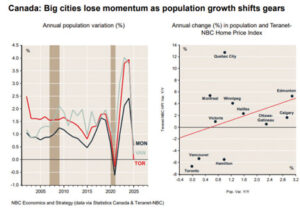
Happy New Year and hope everyone enjoyed a much-needed break over the holidays! This week’s chart will be interesting to readers in the Medicine Hat area as well as other smaller cities as it highlights that population growth is shifting from Canada’s largest cities (Toronto, Montreal and Vancouver shown in the chart on the left) to smaller population centres.
Given population growth is a key driver of home prices (population growth and home price correlation displayed in the chart on the right), smaller population centres are experiencing stronger home price appreciation relative to larger centres like Toronto and Vancouver which are experiencing a decline in home prices after many years of double-digit percentage gains.
Canadian population data for 2025 was released by Statistics Canada last week. It clearly shows the impact of a shift in federal government immigration policy (declining non-permanent residents) with large cities experiencing a more pronounced decrease in population growth relative to the rest of the country.
Growth in metropolitan areas has slowed from 3.6% in 2024 to 1.0% in 2025. However, population growth has slowed significantly less outside major cities (from 1.4% to 0.8%). If we examine population growth in Canada’s three largest cities, you will notice a significant slowdown in Toronto and Vancouver, where population growth has stalled.
Vancouver hasn’t seen population growth this low in more than a quarter century and this abrupt change in immigration has led to a correction in housing prices.
In Toronto, population growth hasn’t been this low since the pandemic. Also of interest, for the first time since this type of population data collection began, Montreal recorded higher population growth than Toronto and Vancouver.
Notice from the correlation chart on the right, Montreal is the only member of Canada’s big three cities to enjoy an increase in home prices last year. This is logical as Montreal experienced higher population growth and has lower absolute housing prices relative to Toronto and Vancouver.
We believe the shift in the federal government’s immigration policy will continue to represent a drag on Canada’s housing market over coming years, with a larger impact in Canada’s biggest cities which were the primary beneficiaries of Trudeau era immigration policies.
However, a counterbalancing mechanism exists with the Bank of Canada lowering short-term interest rates. We acknowledge pent-up demand for new houses, which could be released with lower interest rates and partially offset the negative impact of slower population growth.
Eric Van Enk is a wealth adviser & associate portfolio manager with National Bank Financial in Medicine Hat. He is a graduate of the University of Calgary, as well as a CFA charter holder with 20 years of financial markets experience in New York, Toronto and Calgary. He can be reached at eric.vanenk@nbc.ca