Council looks to set 4.9% tax hike, down from recommended 6.1
By MEDICINE HAT NEWS on April 9, 2026.
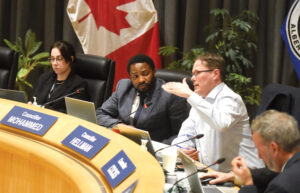
Coun. Chris Hellman speaks during a council meeting in March at city hall. Hellman introduced a motion Tuesday to amend a property tax increase recommendation from 6.1 per cent to 4.9. That motion passed 7-1 and the 2026 rate will now be debated Apr. 20.--NEWS PHOTO BRENDAN MILLER
City council has passed a motion looking to increase property taxes by 4.9 per cent.
It is a lower increase than expected, with previous council meetings indicating a likely jump by 5.6 per cent, and staff recommending an increase of 6.1 per cent.
“We do have different views on what’s an appropriate increase. Some of us are hoping that 4.9 per cent will find enough support to proceed,” said Coun. Bill Cocks. “I am hoping the people of Medicine Hat will realize that we are trying to keep this increase as palatable as possible, but there are realities that have to be confronted.”
Interim managing director and CFO corporate services Lola Barta gave a presentation to council Tuesday evening explaining the rationale behind property tax calculation.
Property taxes are the main source of revenue to fund programs, services and infrastructure.
“Setting tax rates requires judgement,” said Barta. “We must balance fairness, affordability and alignment with our long-term strategic vision.”
The city conducts a property tax assessment annually, where properties are assigned a value as a basis to distribute the revenue requirement among property owners.
A 2026 tax revenue budget of $99.88 million was previously approved by council.
Based on the median home value of $359,500, that comes out to an annual municipal tax of $2,451 per home in Medicine Hat.
Twenty-five per cent of that tax revenue is collected by the city but obligated to other entities, such as the province.
Barta also explained why property taxes increase, saying reduced provincial and federal funding and increased service level challenges have shifted additional costs to the taxpayer.
Fluctuating electricity and natural gas prices have also increased the demand for increased tax revenue.
“When commodity markets shift, so do the contributions from our energy business units. This unpredictability means that there’s less stable revenue available to help offset operating costs,” said Barta.
Tax freezes implemented in 2020-2022 produced a $7.5-million revenue loss to the financial baseline that Barta says the city is still contending with.
In 2025, budget amendments resulted in a total tax increase of 2.11 per cent. As costs rise and projections for city dividend contributions remain low across the next couple of years, Barta says the city needs to raise property taxes to avoid reliance on reserves, or else face increasing deficits.
This year’s provincial education property tax increase is also requisitioning more from the city in a cost that gets passed on to taxpayers.
The province budgeted $500 million more in education property taxes in 2026, resulting in an average increase of 16 per cent across Alberta municipalities.
In Medicine Hat, that translates to an average increase of $82 for the average single-family home.
Barta walked councillors through six budget scenarios offering changes to tax distributions and ratios that would have varying effects on property owners.
City staff requested council approve a scenario in which municipal tax rates were increased by 6.1 per cent for all property classes, including single-family, multi-family and non-residential properties. That scenario would have produced an annual increase of $142 for the average single-family home.
Instead, council directed staff to make amendments reflecting an increase of 4.9 per cent.
Coun. Chris Hellman introduced the motion to amend the recommendation. That motion was passed 7-1 in the chamber. Coun. Brian Varga voted in favour of the motion remotely. Coun. Cheryl Phaff was the lone dissenter.
One of the scenarios presented proposed a tax increase of 4.5 per cent, which would have produced a revenue loss of $1.5 million.
The motion approved would produce a lesser shortfall. Council’s motion called for the deficit to be funded through municipal cost savings and reserves.
The item will be debated at the next meeting of city council on Apr. 20.
27
-26