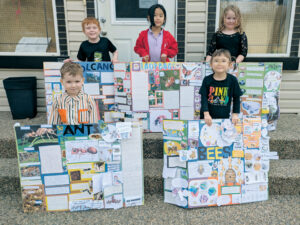
Five-year-old Montessori Children's House students pose with their science fair boards, showcasing months of work and research on a subject of their choice.--Submitted Photo
asmith@medicinehatnews.com
Medicine Hat’s Montessori Children’s House is creating the scientists of tomorrow with their own science fair, which recently offered opportunity for some of the smallest Hatters to demonstrate a love of learning.
Students at the school are too young to participate in larger science fairs on the school level, explained owner and directress Kerrie Gauthier, but are already more than capable of the curiosity, perseverance and creative work required to start their scientific journeys.
“So our five-year-old students get to pick a subject, like an animal, or an insect, or something like a volcano, and they have to research it,” said Gauthier. “They need some assistance, because not all of them are reading at that level yet, but they learn all about their subject, be it their animal’s habitat and what they eat, or whatever the case may be, and we discuss what facts they want to put on their board.”
As there is no computer at Montessori Children’s House, research is done using books, the collection of which Gauthier says may rival the library for how many she’s collected for the school over several decades of teaching.
“So what we basically do is we just give them a variety of all the things that they need to do, some of these projects that they’re working on take them up to three to four months,” said Gauthier.
Through this, the children refine their reading and writing skills, alongside an appreciation for the reality around them, critical thinking and other soft skills which will aid them well into adulthood, says Gauthier, alongside a love of science which may carry them to great work later on in life.
“If you ask any of my five-year-olds about their projects, they know what they wrote,” said Gauthier. “It’s incredible to hear this knowledge coming out of a five-year-old. We teach them worldly things when they’re young, because under the age of six, 90 per cent of these kids will continue in that knowledge, and they’re really making a difference when they’re older.”
Projects were then showcased not only to what for some is their first adjudicator, who would ask them about their projects and the subject of their research, but to their younger peers, teaching communication skills and getting younger children excited to lead their own research in the near future.
Students were also able to partake in age-appropriate experiments, such as constructing volcanoes for baking soda lava or learning about the states of matter and glacier ice through seeing how different conditions can change the rate at which ice melts.
“These kids, they’re independent. There isn’t one of them who will say they can’t do it. They’re self driven, and they all have that will to work and to continue, that’s instilled in them because it’s taught under the age of six,” said Gauthier. “So what they decide that they want to do, they will do it, and they will push through it. It’s absolutely wonderful.”