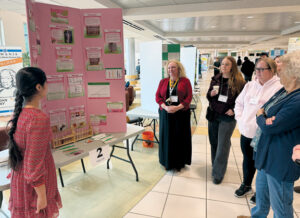
Hania Riaz explains her biofuel experiment to Southeast Alberta Regional Science Fair guests on Saturday at Medicine Hat College.--NEWS PHOTO ANNA SMITH
asmith@medicinehatnews.com
Medicine Hat College held the work of 100 brilliant minds much younger than usual on Saturday, as it once again hosted the Southeast Alberta Regional Science Fair.
This year saw students from as young as Grade 4 to those facing graduation later this spring all under one roof to showcase their work in all manner of fields, all pursuing a question which has personally sparked their curiosity.
Hania Riaz, a Grade 7 student, tackled the question of alternative fuel, and attempted to determine what plants could potentially yield the most ethanol for use as a biofuel, by measuring the reaction of a yeast and plant mixture.
“Biofuel is a renewable fuel which is made from plants. So biofuels are actually very eco-friendly, as they don’t produce much CO2 in the environment, which is a big problem in today’s world. They also help create more jobs in the industry, and are more sustainable,” said Hania.
Other projects covered subjects such as the use of cleaning supplies and their effect on water plants like duckweed, with applications for household water usage and how it could potentially affect the environment, to the work of Medicine Hat High School student Zainab Riaz, who conducted research with the University of Lethbridge’s Department of Computer Science on better ways to anonymize data as to safely use for medical research.
She posited that via machine learning, similar patients could be condensed into clusters, which could be used to collect information on specific medical trends and procedures without revealing identities of the patients.
“In order to evaluate the usability of my data and also just the degree of anonymization, I used a forecasting model, and it’s called ARIMA. You feed it historical values, and it will predict what the next business will be,” said Zainab. “So I fed the centroid, or generalized data, into the forecasting model, and then it gave me the predictions. I compared those predictions with the actual data column that I originally was working with.”
She found while the research was more exploratory in nature, the predictions she received had a very low level of error compared to the actual data set.
Over on the younger end of the fair, Grade 6 student Lucas Wegulin studied the relationship between the mass of a ball and the speed at which it would travel when kicked, correctly hypothesizing a ball with medium mass would be able to travel the fastest, compared to heavier or lighter subjects.
“I kicked each ball from the same line into a net five times, and took the average speed since I knew it would be hard to kick each ball with the same amount of force every time,” said Wegulin, explaining he measured the balls with a radar gun.
Senior science consultant Patty Rooks said she considered the event a massive success, and expressed gratitude to all the students, teachers and parents for their work with the projects, and to their volunteers and sponsors for facilitating another great year of learning.