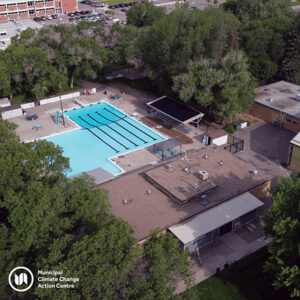
Solar panels at Hill Pool were installed on top of a shade structure. They generate 12,423 kWh of electrical energy per year.--Image courtesy Municipal Climate Change Action Centre
zmason@medicinehatnews.com
A funding stream for municipal climate action is drying up, according to provincial budget documents.
The Municipal Climate Change Action Centre has offered up to $500,000 in funding on a matching basis to 175 municipalities since 2009. Budget 2026 suggests the province will stop funding it after this cycle.
“The city has been really fortunate in receiving fairly substantial grant funding from two of the MCCAC programs, the Municipal Energy Generation Program and the Community Energy Conservation Program,” said Melanie Friesen, grant revenue development specialist with the City of Medicine Hat.
The City of Medicine Hat received more than $700,000 in the last three years through MCCAC programs.
Recent projects included a 24-panel solar array at Hill Pool and a broad-reaching LED retrofitting overhaul at 12 city-owned facilities. City hall, Co-op Place and Medicine Hat Regional Airport were included in the initiative, which used nearly all the $500,000 available through the MCCAC.
That project is estimated to reduce CO2 emissions by almost 400 tonnes per year and costs by almost $100,000 a year.
Friesen says the MCCAC is one of the best funding agencies to work with, calling it responsive, organized and client-focused.
Since 2019, the province has supplied the MCCAC with $24.1 million in grant funding. An $18 million majority came from the Technology Innovation and Emissions Reduction fund to expand the two programs Medicine Hat has benefitted from.
Friesen says the city recently had two additional projects approved. Applications for the programs are open until Mar. 31 or until funding is fully allocated.
In a statement to the News, the office of Minister of Environment and Protected Areas Grant Hunter said MCCAC programs are funded through grant allocations, meaning they operate within defined funding windows.
“There are no updates to share at this time beyond the existing funding commitments,” reads the statement.
The ministry did not respond to a question about the future of the Municipal Electricity Generation Program and the Community Energy Conservation Program.
“It’s not uncommon to see individual grant programs have an end-life, and then new programs are invented based on those changing priorities,” said Friesen.
“I hope that is the case, and there will be new programs rolling out to fill that gap. I’d be really disappointed if the MCCAC itself was completely defunded, because municipalities are struggling to keep up with the increase cost of infrastructure.”
Friesen says allocation-based funding is not keeping up with the growing pace of capital pressures. Competitive grant funding programs like those facilitated by the MCCAC help fill that gap.
Budget 2026 did not include any increase for the Local Government Fiscal Framework capital funding, an absence criticized by Alberta Municipalities after the budget’s release.
The UCP government has adopted a number of policies perceived as detrimental to the renewable energy sector, the primary focus of MCCAC programs. In addition to a seven-month moratorium on new renewable projects in 2023, the energy market redesign unveiled last year has been criticized as detrimental to renewable generators.
The MCCAC did not respond to a request for comment about the future of the program as a whole.