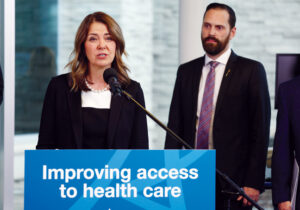
Premier Danielle Smith and Matt Jones, minister of hospitals, make a health-care announcement in Calgary on Nov. 14, 2025.--CP FILE PHOTO
zmason@medicinehatnews.com
Health-care spending is set to reach record highs in 2026-27, including more than $2 billion in costs related to the new corporate services corporation.
Alberta’s Budget 2026 includes $34.4 billion in total health-care spending, $2 billion more than in 2025.
Health care represents 41 per cent of the total budget.
“Budget 2026 is our plan to face a hard year head on,” Finance Minster Nate Horner said last week. “It focuses on what matters, makes careful choices and takes decisive action where it counts.”
Health Shared Services, the provincial corporation created by the UCP government to centralize corporate services between the four health agencies, is set to receive $2.3 billion.
Health Shared Services will be responsible for delivering information technology, finance, human resources and other support services. The fiscal plan says HSS will reduce duplication and enhance co-ordination across the health-care agencies.
The Canadian Institute of Health Information reports on the corporate service expense ratio as a financial performance indicator, calculating a rate based on the percentage of total expenses.
According to the 2024-25 annual report from Alberta Health Services, AHS spent 3 per cent of its total expenses on corporate services. This represented the lowest rate among Canadian provinces that year.
The $2.3 billion allocated to HSS represents 6.7 per cent of the record-high health-care budget for 2026-27.
In 2025, the province with the highest corporate service expense ratio was Ontario, at 5.8 per cent.
CIHI did not respond to a request for clarification in time for publication as to whether the HSS budget will comprise Alberta’s corporate service expense ratio.
The majority of the health-care funding will be allocated to Hospital and Surgical Health Services. The ministry responsible for acute care service delivery budgeted a total spend of $13.8 billion for 2026-27, $830 million more than in Budget 2025.
The HSHS budget will climb again next year to $15.1 billion, representing an average increase of 5 per cent per year since 2025.
Of the 2026-27 total, $525 million is being allocated to increase the number of surgeries performed over the next three years by 50,000.
It is unclear what portion of those surgeries are expected to be performed in chartered surgical facilities and which will take place in public hospitals.
Another $91 million has been earmarked for various measures designed to increase system capacity, including expanding emergency department and operating room capacity, increasing the anesthesia and surgical workforce and freeing up spaces used by alternate level of care patients.
Primary and Preventative Health Services is budgeting to spend the next biggest sum, with projected expenses totalling $12.7 billion, $409 million more than the third-quarter forecast from the previous budget.
Total expenses are projected to rise to $13.3 billion by next year and $14.1 billion by 2028-29 for an average of 5.6 per cent per year over the course of the three-year fiscal plan.
Most of that increase is attributable to physician compensation and rising drug costs.
The Alberta government announced a record $7.7-billion investment in physician compensation shortly before the release of Budget 2026.
The remainder of the health-care budget is split between Mental Health and Addiction, which received an 8.9 per cent bump for a total expense of $2 billion, and Assisted Living and Social Services, which is scheduled to spend $5.9 billion on health initiatives, 5.1 per cent more than the previous year.
In a statement released Friday, the Alberta Medical Association noted the substantial increase to physician compensation compared to last year’s budget, which the AMA says did not account for population growth, aging and inflation.
It says that compared to the actual spend in 2025-26, the increase is more modest, falling from 2.2 per cent to 1.6 per cent.
“Based on the information available, it is not clear how this funding fully addresses ongoing cost pressures, previously awarded arbitration decisions or other known commitments affecting physician services,” reads the AMA statement.
Friends of Medicare president Chris Gallaway says the budget fails to adequately address the ongoing workforce pressures felt in emergency rooms across the province.
“We didn’t see that in (the) budget. It doesn’t matter how many doctors they promise to fund if they don’t stick around, or they’re not where patients need them, like in our ERs where people are dying while waiting to be seen, or in the dozens of community facilities facing repeated temporary closures,” Gallaway said in a statement last Thursday.
Triage physician role
At a budget-related press conference Tuesday, Jones faced questions about the continued stall of the triage liaison physician program, which was scheduled to roll out Feb. 1 to relieve pressure on over-burdened ERs. It has yet to launch.
The AMA and the government reached an agreement last year on the modernization of the alternative relationship plans used to compensate physicians, but the proposed terms of the triage physician role failed to meet the terms established in that agreement, reverting to an outdated methodology.
The AMA sent a counter-proposal to the Alberta government asking for term changes for the role that included increases to base pay, after hours modifiers and expanded liability coverage.
As most of the demands in the letter remain outstanding, the AMA has advised members not to sign up to fill the role.
Jones said follow-up meetings with the AMA are scheduled.
“We’ve accepted the after hours request, and I’m hoping in these subsequent meetings we’ll be able to work through the others. I think we all agree that this position will be beneficial to patients,” said Jones.
Responding to a question about how the government would proceed if an agreement cannot be reached with AMA, Jones said nurses could be used to fill the role.
Jones said he does not blame the AMA for the standstill on the implementation of the role.
“There’s two sides to this, and I take accountability for our side of it.”
When asked Monday about the delay, Premier Danielle Smith told reporters to ask the AMA.
In a conversation with the News on Feb. 13, Dr. Warren Thirsk, the AMA’s head of emergency medicine, said he had not been invited to discuss his suggestions with government decision-makers.
“This is not a conversation. Never even got close to a negotiation, because that would require back and forth,” said Thirsk.