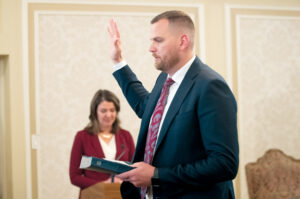
UCP government house leader Joseph Schow on Tuesday previewed a number of bills to be tabled in the upcoming spring sitting of the legislature. Schow is sworn into cabinet in Edmonton by Danielle Smith in this file photo.--CP FILE PHOTO
zmason@medicinehatnews.com
Ahead of the start of the first sitting of 2026, government house leader Joseph Schow outlined UCP government priorities for the spring session of the legislature.
With a deficit budget set to be released Thursday, Schow says the government will focus on key priorities like education, health care and building infrastructure during this session.
The legislative agenda will also feature issues like immigration and medical assistance in dying.
Schow told reporters Tuesday that Albertans can expect 17 or 18 bills tabled this session, although that number is subject to change as the session plays out.
The government also plans to introduce legislation granting itself new authority over immigration following Premier Danielle Smith’s announcement of a referendum that would grant further sweeping powers to the province.
The powers granted by the legislation planned for the spring would, according to the UCP, allow the government of Alberta to exercise more control over the immigration system by implementing a licensing process and increasing oversight for employers who participate in the recruitment of foreign workers.
Schow also said the government will introduce legislation to prohibit medical assistance in dying in the province for select groups, including “mature minors,” individuals with a mental illness as their sole underlying condition and adults without health-care decision-making capacity.
Schow was also asked to clarify his government’s plans to implement results of the referendum questions announced by Smith on Thursday.
During an address to the province last week, Smith announced nine questions to be put to referendum in October, including five on provincial immigration policy and four on constitutional amendments.
Smith later clarified that if the ongoing petition on Alberta independence garners the requisite number of signatures, a question on separation could be added to the ballot.
The non-constitutional questions are phrased in a manner that presumes Alberta remains a province within the Canadian federation.
Schow declined to clarify on whether implementation of results of the questions on immigration would conflict with implementation of results of the question on separation.
“I think it’s premature to ask that question today,” he said.
Reporters also asked Schow about an order paper issued Tuesday that outlines changes to the procedure for written questions and motions for return that limit the number of questions an MLA can submit and extend the timeline in which the government is required to respond.
Alberta Tory Leader and MLA Peter Guthrie has 10 written questions and eight motions for return to be submitted to the legislature, covering topics ranging from Alberta Health Services severance spending to policing costs and renewable energy project cancellations.
Tuesday’s order paper alters the timeline from 30 to 120 sitting days for the government to respond to written questions. The change will effectively allow the government to let all current written questions – including Guthrie’s – linger well beyond this sitting, and as far as years down the road.
Schow says he thinks the change will benefit the legislature by preventing one MLA from occupying an entire day of private members business.
In response to a question about whether Albertans deserved a timely response to questions submitted by their elected officials, Schow said “I think they’re getting it.”
Schow confirmed the government plans to establish a bipartisan committee to examine the proposal put forth by the Forever Canadian petition this session.
The Forever Canadian petition was verified as surpassing the required number of signatures to advance to in December.
The petition asks: “Do you agree that Alberta should remain within Canada?”
Its proponent, former deputy premier Thomas Lukaszuk, said his intention was for the petition question to be called in the legislature for MLAs to vote on rather than put to referendum.
When pushed to clarify whether Albertans would know whether their MLAs were for or against separation prior to a potential referendum in the fall, Schow said it is too early to comment on any further outcomes.
When asked to clarify his own stance on Alberta separation, Schow said he has not signed the petition himself, but expressed his support for the ongoing citizen initiative process.
“What I have supported from the beginning, since 2019, was the establishment of a citizen’s initiative referendum. I fought hard with Jason Kenny and now with Premier Smith, who lowered the threshold to make sure that our burdens have their say with this petition.”
Schow said regulatory burdens have been significantly reduced by the new federal government, and praised Smith for her advocacy resulting in the Ottawa-Alberta memorandum of understanding.