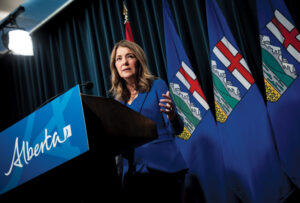
Premier Danielle Smith answers questions at a news conference in Calgary on Friday.--cp photo Todd Korol
zmason@medicinehatnews.com
Premier Danielle Smith provided more details at a media availability Friday about the referendum coming in October.
Smith announced the referendum during her address to the province Thursday night. The referendum poses nine questions to Albertans, including several non-constitutional questions about the future of Alberta’s immigration policy and a number of constitutional questions seeking amendments that grant Alberta new powers within the Canadian federation.
The referendum is scheduled for Oct. 19.
Smith said her government is seeking a democratic mandate to implement changes that represent “a serious departure from the way we do things now.”
Although the set of four constitutional questions are concerned with what Smith calls “strengthening Alberta’s position within a united Canada,” the premier told reporters Friday that a proposed question about Alberta independence could ultimately appear on the ballot.
“The view that our government has is that these are the kinds of things that will give Albertans hope that the federation can work. This is why we put them on the table.”
However, she says if the citizen initiative petitions that are now collecting signatures meet the requisite number to advance, her government would add those referendum questions to the ballot.
Smith mentioned the Alberta independence petition and the petition against coal mining on the eastern slopes of the Rockies. She did not mention the Forever Canada petition, which collected 456,000 signatures, far exceeding the 294,000 required to proceed.
Justice Minister and Attorney General Mickey Amery, also present at Friday’s availability, said the government is bound to take steps to implement the results of the constitutional questions.
Whether action based on the results of non-constitutional referendum proceeds would be the decision of the Lieutenant Governor in Council. But Amery said his government will move forward based on the results they receive.
“My personal view is that you don’t ask questions of the people unless you want to act on the results you get,” added Smith.
The premier says the non-constitutional questions were based on feedback her government received during last fall’s Alberta Next Panel tour.
One question asks whether Albertans support the government in mandating that only individuals with an “Alberta-approved immigration status” will be eligible for provincially-funded programs like education and health care.
Smith says she envisions Alberta adopting a system similar to Quebec’s, where the 1991 Canada-Quebec Accord granted the province exclusive responsibility for selecting economic immigrants and determining the number of economic immigrants it receives.
According to the policy Smith proposes, immigrants with a temporary residency status will not be eligible for social services like health care and education without paying a premium.
She says every child in the K-12 education system costs the government $12,000. Last year, she says the children of temporary residents cost a total of $500 million.
She did not provide an estimate for the total cost of temporary residents for access to education or health care, or the estimated savings should those residents lose access to those services.
Smith said Friday the province has never seen its finances simultaneously squeezed by slagging oil prices and such population growth, so it needs to address “out-of-control” temporary residents.
“Every new arrival, particularly if they bring their family, draws on Alberta’s public services,” she said. “Not every newcomer is a net contributor to the provincial revenues that fund those services.”
Smith was unable to say if the policy changes would be enough to eliminate what’s expected to be a multi-billion-dollar deficit this year. And she didn’t provide a total estimate for health-care and education savings.
“We’d have to do the figuring out,” she said.
When asked if she would commit to sharing that data in the future, the premier said “if we can get it, for sure.”
She added there are about 225,000 residents in Alberta who drive about $14 to $16 billion in spending.
“I don’t know what the breakdown is between those who are permanent residents, Canadian citizens or temporary workers, but we’ve got to find that out.”
The premier also didn’t offer an estimate of how many new Albertans might be affected if referendum questions are approved.
Smith says other provinces, like Ontario, already deny temporary residents and their families access to health care.
“What we’re talking about is making sure the services are prioritized to the people who have registered a permanent stake in our country and our province. That’s Canadian citizens and permanent residents. Temporary individuals should be treated as that – temporary, and tourists.”
Smith also reiterated her position that Alberta should have greater input into federal judicial appointments.
“I mean, we asked for a collaborative approach and that was quickly shot down,” added Amery.
Federal Justice Minister Sean Fraser said the federal government would not be making changes to the appointment process.
At the end of January, the Chief Justices of Alberta Courts released a joint statement defending the independence of the judicial system after the premier made a comment on her radio show about wishing she could “direct the judges.”
— with files from The Canadian Press