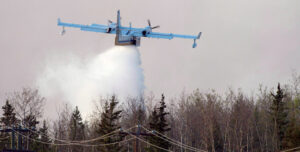
A water bomber drops its load on a wildfire 16 km south of Fort McMurray in this May 2016 file photo.--CP FILE PHOTO
zmason@medicinehatnews.com
The Alberta government announced Tuesday a $400-million investment into five new water bombers to expand the province’s wildfire response capacity.
The province has secured a contract with De Havilland Canada to procure the DHC-515 water bombers, which Minister of Forestry and Parks Todd Loewen says are substantially faster and more efficient than Alberta’s existing CL-215 aircraft.
The new tankers can fly up to 330 km/h, 15 per cent faster than the province’s existing fleet, and can refill its tanks in 12 seconds. Their tanks can also carry up to 6,137 litres of water, 15 per cent more than the older aircraft.
The investment represents a nearly 60 per cent increase in Alberta’s total drop capacity. In 2025, there were 18 airtankers ready to respond to wildfires in Alberta, including four Alberta-owned and contracted aircraft.
The existing government-owned aircraft were built between 1986 and 1988. Loewen says they still have many years left on their lifespan.
“Alberta’s face significant wildfire challenges in recent years, and we continue to explore new ways we can improve our wildfire fighting capabilities and prepare ourselves for future wildfire seasons,” said Loewen at a press conference Tuesday.
Loewen said other wildfire mitigation and response strategies the province has adopted over the last few years include adding night-vision helicopters to the fleet to increase the ability to fight fires at night, as well as the continued implementation of FireSmart and community fireguard programs.
The province also experimented for the first time last season with a hoist program that can drop firefighting teams into targeted areas using helicopters.
Officials said Tuesday the new investment is also expected to provide welcome stimulation to the Alberta economy and retain manufacturing locally amid ongoing international trade pressures.
The new investment is expected by government to produce 1,000 jobs in the province.
CEO of De Havilland Canada Brian Chafe emphasized the Canadian heritage of the company. He says the contract with the Alberta government represents an alignment with the new federal defence industrial strategy.
“I don’t know that there’s anything more pressing than defending Canada from wildfires. We’ve all seen the destruction across the country,” he said. “When you look at that strategy, it’s about investing in Canadian companies, companies that have IP and a lot of significant employment in Canada.”
De Havilland Canada relocated its headquarters to Alberta in 2022 and is building a new manufacturing facility in Wheatland County.
Chafe says more than 80 per cent of De Havilland’s aircraft are manufactured in Canada or sourced by Canadian companies.
The first new aircraft is expected to arrive by spring 2031.
The water bomber investment adds to the existing $160-million budgeted annually toward the province’s wildfire response.
Loewen says early projections forecast a normal start to the wildfire season, which begins in March.
Last season, the first wildfires of the year were reported in southern Alberta in late February. The first evacuation due to wildfire was ordered in late April in central Alberta.
Alberta saw 1,260 wildfires last year, the second most among Canadian provinces, with the estimated area burned continuing to trend above the 10-year average.