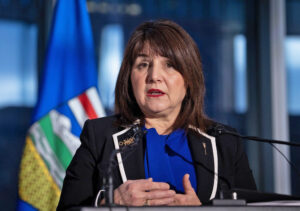
THE CANADIAN PRESS Todd Korol
Minister of Primary and Preventative Health Services Adriana LaGrange says her government remains committed to upholding the Canada Health Act. The federal government has yet to comment on new provincial laws inviting more private practice into Alberta's health system.
zmason@medicinehatnews.com
An open letter signed by ten Canadian health coalitions is calling on the federal government to respond to Alberta’s law enabling dual practice in the province.
The coalitions, together representing more than three million Canadians, argue that Alberta’s Bill 11, which was passed last week, represents a violation of the Canada Health Act.
Alberta’s Friends of Medicare and the Canadian Health Coalition were joined by eight provincial organizations in signing the letter, including provincial coalitions from Quebec and New Brunswick.
The Health Statutes Amendment Act introduced a framework that allows certain physicians in the province to practice in both the public and private systems concurrently.
At a press conference in November, Minister of Primary and Preventative Health Services Adriana LaGrange said she believes the law falls within the parameters established by the Canada Health Act.
“We know this happens already in Quebec and New Brunswick,” she said. “In New Brunswick, a physician can toggle on a case-by-case basis to provide public or private service.
“Our emphasis has always been to make sure it’s compliant with the Canada Health Act. I don’t see how it could not be compliant when other provinces are doing it.”
To date, the federal government has issued no comment regarding Alberta’s introduction of the dual practice model.
“We need to hear from our federal government, and we haven’t been hearing from the prime minister or the Minister of Health about this, and we think it’s their role to comment on this, to enforce the Canada Health Act, and actually speak up on what’s happening, because Canadians support public health care,” said Chris Gallaway, executive director of Friends of Medicare.
It is the responsibility of the federal Minister of Health to interpret the Canada Health Act. Steven Staples, national director of policy and advocacy at the Canadian Health Coalition, says early conversations with experts have indicated there are grounds for a case the law contravenes the Canada Health Act.
Staples points to the 2023 British Columbia Supreme Court decision, in which a private surgical clinic lost a battle to strike down the sections of B.C.’s Medicare Protection Act that require public and private health care to operate as two separate systems with no financial connection.
In a statement following the outcome of that case, then federal Minister of Health Jean-Yves Duclos released a statement endorsing the outcome.
“As we continue our collaboration with provinces and territories to strengthen public health care across the country, we will do so without supporting a two-tier health system that benefits few and leaves many worse off,” he said.
“Our government will always defend the values and principles that uphold the Canada Health Act and ensure that everyone, no matter where they live, can get the care they deserve based on their need and not their ability to pay.”
Tuesday’s letter, addressed to Prime Minister Mark Carney and federal Minister of Health Marjorie Michel, demands the federal government take action to address the changes outlined in the new Alberta law, which it describes as a threat to national public health care.
“We must be clear. The new Alberta legislation expressly creates private health insurance and brings in charges to patients for medically needed health care. It will drive the creation of a market for private insurance in Canada, threatening public health care across the country,” reads the letter.
The goal of the letter is to prompt a response from federal government. It is the responsibility of the federal Minister of Health to interpret the Canada Health Act. Gallaway says if the Minister determines Alberta is contravening the act, Ottawa could choose to withhold the federal health care transfers the province receives.
Staples said that kind of action would be a long way off. But while provinces make changes to the delivery of health care within their borders all the time, the nationwide concern about the bill highlights the magnitude of this particular change.
“In this case, because it’s such a profound challenge to the basic spirit of our Canadian Medicare system that advocates in other provinces are concerned that it could spread like a virus to other governments.”
He says Canadians from coast to coast are regarding it as a wakeup call.
“You’ve got to remember, the Health Act is only 40 years old. We can’t take it for granted. We have to constantly defend it. And that’s what we’re appealing to the federal government to do.”