It’s Old News: An attack on women
By MEDICINE HAT NEWS on December 4, 2025.

News Archives
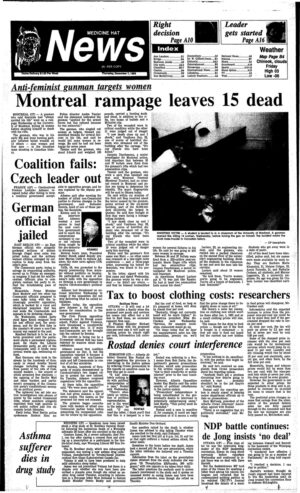
One of the darkest days in Canada’s history continues to be a spotlight for the fight against gender-based violence.
On Dec. 6, 1989, 14 women were murdered in an anti-feminist attack at the École Polytechnique de Montréal in what is still the second deadliest mass shooting in Canada. Another 10 women and four men were injured in the shooting.
Shooter Marc Lépine, armed with a legally-obtained Ruger Mini-14, semi-automatic rifle and a hunting knife, entered a mechanical engineering class at the École Polytechnique and ordered women to one side of the classroom while also instructing the men to leave.
He claimed to be fighting feminism, shooting nine women, killing six, in the first room before moving through corridors, the cafeteria and another classroom all while targeting more women. The attack lasted just under 20 minutes, killing eight more women before the 25-year-old turned the gun on himself.
Lépine blamed unidentified women for several failures in his life and said he would kill some women in revenge.
“I saw death close up and I shook,” Vanthona Ouy, 22, told The Canadian Press in the Dec. 7, 1989 edition of the News.
“It’s our friends who have been killed.”
The News is looking back at notable events from history as we celebrated our 140th publishing year on Oct. 29.
Eyewitness Robert Leclerc recalled the attack, describing the gunman as Rambo-like. The then 23-year-old engineering student described Lépine’s tactics.
“He told them, ‘You’re women, you’re going to be engineers. You’re all a bunch of feminists. I hate feminists!'”
Since 1991, Dec. 6 has been known as National Day of Remembrance and Action on Violence Against Women.
The Montreal Massacre brought attention to the Canadian women’s movement, which saw the attack as a symbol of violence against women.
In response to the killings, a House of Commons Sub-Committee on the Status of Women was created. It released a report, “The War against Women” in 1991. Following its recommendations, the federal government established the Canadian Panel on Violence Against Women in August of the same year.
The panel proposed a two-pronged National Action Plan, consisting of an Equality Action Plan and a Zero Tolerance Policy designed to both increase women’s equality and reduce violence against women through government policy.
The massacre was also a spur for the gun control moment in Canada. After petitions started by victims and their families, the passing of Bill C-17 in 1992 and C-68, known as the Firearms Act, in 1995, ushered in stricter gun control regulations.
These new regulations included requirements on the training of gun owners, screening of firearm applicants, a 28-day waiting period on new applicants, rules concerning safe firearm and ammunition storage, the registration of all firearms, magazine capacity limits for semi automatic rifles and pistols and reclassifying other firearms as restricted or prohibited.
In 2020, in the wake of the mass killing in Nova Scotia, Canada’s deadliest shooting, Prime Minister Justin Trudeau cited both it and the École Polytechnique massacre when he announced a ban of around 1,500 models of military-grade assault-style weapons, including the Ruger Mini-14 used for the killings in Montreal.
On Saturday, the Medicine Hat Women’s Shelter Society will host its annual vigil at Medicine Hat College for the victims of the 1989 Montreal Massacre, and tall hose who lost their lives to gender-based violence across Canada this past year.
19
-18