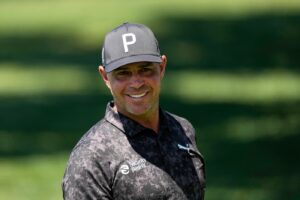
Gary Woodland details PTSD struggles ahead of the Masters: ‘I thought people were trying to kill me’
By Canadian Press on April 7, 2026.
AUGUSTA, Ga. (AP) — Gary Woodland was playing the back nine at the
Houston Open a couple of weeks ago, an event he would ultimately win to secure his return trip to
the Masters, when the former U.S. Open champion began to feel what he described as “hypervigilant.”
“I battled the last 10 holes,” Woodland revealed Tuesday, “thinking people were trying to kill me.”
That’s not intended to be a joke. The exact opposite, in fact: a powerful admission of Woodland’s mental health struggles, and one he hopes will help others dealing with trauma, anxiety and post-traumatic stress disorder in their own lives.
The inner turmoil that Woodland feels even at Augusta National, one of the most bucolic places in the world, has its roots in a scan that uncovered
a lesion on his brain that had been causing him unfounded fears of dying. In September 2023, he wrote letters to his wife and kids in the event something went wrong, then had surgery to remove as much of it as possible.
The procedure involved cutting a baseball-sized hole from the side of his head, but it proved to be successful. Woodland was back on the course in January 2024, slowly working his way back into form, making enough cuts to keep him motivated.
The following year, he finished second at the Houston Open — the same tournament he would win last month, when Woodland got through his Friday bout of hypervigilance and closed with a 3-under 67 on Sunday for a five-shot win over Nicolai Hojgaard.
Few knew that Woodland was still struggling, though. He had become crippled by PTSD to the point that he would rush to bathrooms to break down in tears, and it always felt as if people were out to get him; one symptom of PTSD is a heightened state of sensory sensitivity, which causes the nervous system to continually stay in an on-guard state.
“I talked to (PGA) Tour security that night,” Woodland said of that Friday at the Houston Open, “and I told them what I was going through, and every time I looked up on the weekend, my security team was behind me. Any time I got startled on the weekend, I turn around — last year I didn’t talk to Tour security. I fought this on my own. It was awful.
“Turning around and knowing I’m safe, having somebody there with me? It’s the only reason I won two weeks ago.”
Well, not quite the only reason.
Woodland’s ball speed was 196 mph on one tee shot, a good indication that the strength that helped carry him to the
2019 U.S. Open championship had returned. His approach play was sublime and his short game even better on the way to finishing at 21 under, giving Woodland his first win since his only major championship and the fifth victory of his career.
“We live in a world, as men and especially as an athlete, that you put your head down and you fight through it. I’ve done it my whole life,” Woodland said. “This is honestly one battle that I’m not able to do on my own. I tried, and it wasn’t working.”
So, Woodland got some help. And it has helped him immeasurably.
Never one to think about himself, Woodland quickly realized that his struggles might help somebody else, too. That is why he went public with his PTSD diagnosis in an interview with the Golf Channel, and why he was so forthcoming Tuesday at the Masters.
“The world we live in, speaking about something you would call a weakness is hard,” he said, “but speaking about it and how I feel afterwards made me a lot stronger. I didn’t know that releasing this battle was going to make me stronger, and it’s done that. I feel a lot stronger now than I did three weeks ago, I can tell you that. No matter how hard it is out here, I know I have someone I can talk to that I can have security. My team have been amazing in helping me, but I’ve turned a weakness into a strength.
“I wouldn’t even say it as a weakness, but I think that’s the stigma out there. But I feel a lot stronger after I came out for sure.”
This week will be another test for Woodland, perhaps an even tougher one. More people are sure to trail him around Augusta National after his win in Houston, and the proximity of the patrons to the players — especially on the tees — can be a matter of a few feet.
The PGA Tour has worked with the Masters to provide the security Woodland needs to feel safe.
“There’s probably not a safer golf tournament in the world, so I’m happy for that, but it’s still a battle in my head if I’m safe or not,” he said. “I don’t have control when this thing hits me, and it’s tough. It can be a fan. It can be a walking score (board holder). It can be a camera guy running by me. Just any startlement from behind me can trigger this pretty quickly. Knowing where that security is is a constant reminder that I’m safe.”
___
AP golf:
https://apnews.com/hub/golf
Dave Skretta, The Associated Press
25
-24