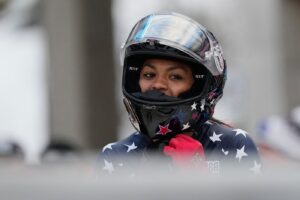
Diversity still a major issue at the Winter Olympics. The US is making some strides
By Canadian Press on January 14, 2026.
LAKE PLACID, N.Y. (AP) — When USA Bobsled and Skeleton unveils its Olympic rosters, the most likely scenario is that either eight or nine women will wind up competing for that federation on the ice at the
Milan Cortina Winter Games.
Most of those sliders will almost certainly be women of color.
By the time the Games open, this could be the most diverse U.S. Olympic winter roster ever assembled. The 2018 U.S. roster for the 2018 Games included 21 athletes of either Black or Asian descent, about 8% of the total; the 2026 team could top that number. There is still obvious potential for far more growth on the diversity front, but some athletes feel that steps are being taken in the right direction.
“We’re really doing this,” said U.S. skeleton athlete Mystique Ro, a woman of Black and Korean descent and someone who teamed with Austin Florian to win last year’s world championship in the sport’s mixed event. “The train has left the station. We’re going. And it’s such a surreal feeling. … We’re really making history out here and it’s not slowing down at all.”
People of color fill the rosters for non-traditional winter sports
nations like Jamaica but most of the dominant teams from European powers — and, to be fair, the U.S. as well — are almost entirely white. Still, some of the top American medal hopefuls at these Olympics will be Black women, and that’s not exactly a new phenomenon — especially in bobsled.
Bobsledder Elana Meyers Taylor is a five-time Olympic medalist and is the most decorated Black athlete in Winter Games history. Kaysha Love is the reigning world champion in monobob, making her the first Black woman to hold that title. Speedskater Erin Jackson, who in 2022 became the first Black woman to win Olympic winter gold in an individual sport, is back for more in 2026. Laila Edwards is a rising star of the powerhouse U.S. women’s hockey team and will be the first Black woman to wear the American sweater on the Olympic stage.
“It’s a really big deal,” Edwards said when the roster was unveiled. “Representation matters. In terms of processing it, I think I’m just trying to use it as something that motivates me to be the best role model and person I can be.”
It also remains clear that the sports offered as part of the Winter Olympic program seem to come with fewer opportunities for athletes of color. The National Ski Areas Association said in 2024 that, of all guests who visit U.S. ski resorts, about 1% identify as Black. The reasons most commonly cited are cost and accessibility: many winter sports are expensive and ski areas are generally remote.
Of the 2,900 or so athletes who competed at the most recent Winter Games in Beijing, the overwhelming majority of them identified white. There was a smattering of non-traditional winter sports nations to see athletes qualify — Ghana, Nigeria and Haiti among them — and the impact that Jamaica’s famed “Cool Runnings” bobsled team had when it debuted at the Olympics a generation ago is still felt today.
“I never thought I would be doing this.” said bobsledder Adanna Johnson, who was 17 when she competed for Jamaica at last year’s world championships. “The sport is growing. There are more opportunities.”
Much more needs to be done, Ro said, particularly in the years where the Winter Olympic spotlight doesn’t shine on these sports.
“There’s a lot more diversity,” Ro said. “But seeing us without the helmet, seeing the roster, seeing the names, it’s just really important how we present it to the people so it’s not just at the Olympics. It has to be every year because we compete every year.”
Almost every person who has made a national team over the last few decades came to bobsled after being recruited from another sport — often track, since bobsled thrives on a combination of speed and power. Vonetta Flowers was the first Black woman to win a bobsled medal for the U.S., teaming with Jill Bakken for gold at the Salt Lake City Games in 2002, and the Americans have seen women of color make their way to the medal stand steadily ever since.
Meyers Taylor, an elite softball player in college, counts Flowers as one of her top inspirations. So does Love, who was a record-setting sprinter in high school who went on to UNLV. She then got invited to try bobsled and is about to become a two-time Olympian.
She always knew she’d get there. She just thought it’d be in gymnastics.
“Growing up, I was really only excited about summer sports because that’s where I saw me. That’s where I saw representation,” Love said. “You always had Black athletes in gymnastics and track and even swimming sometimes. So, to know that now I get to be that representation along with like some of my other teammates who have worked so hard to be a part of this … that change is inspiring.”
___
AP Olympics:
https://apnews.com/hub/milan-cortina-2026-winter-olympics
Tim Reynolds, The Associated Press
22
-21