OTTAWA — Two First Nations chiefs are calling on Prime Minister Mark Carney to apologize for saying he could “outlast” a First Nations woman who was protesting over mercury poisoning in her community.
Chrissy Isaacs, a Grassy Narrows woman suffering from mercury poisoning, was in Toronto on Monday to demand compensation from the provincial government for mercury contamination.
The Dryden Paper Mill released thousands of kilograms of mercury into Grassy Narrows’ river system from the 1960s to the 1970s. It’s widely considered to be one of the country’s worst environmental disasters and community members are still dealing with the fallout today.
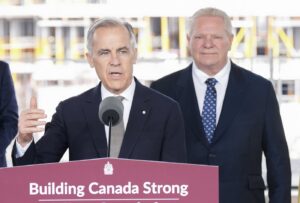
Isaacs and a group of community members and their supporters attended a news conference Carney held on Monday with Ontario Premier Doug Ford to announce new funding for housing. She and the other protesters could be heard chanting and shouting in the background about the mercury contamination.
“I can outlast her,” Carney said, laughing briefly along with Ford and Toronto Mayor Olivia Chow.
Grassy Narrows First Nation Chief Sherry Ackabee said Carney should apologize for his remark.
“Shame on you, prime minister. You’re making a joke of my people,” Chief Ackabee told The Canadian Press.
“And for all the people laughing behind him, shame on all of you.”
Chief Roland Fisher of Wabaseemoong Independent Nations said governments should not dismiss the concerns of his community members and called on Carney to meet with them.
The Prime Minister’s Office said in a media statement Carney could not hear what the demonstrators were saying and that members of his staff spoke to the demonstrators to hear their concerns. It’s not clear if the prime minister knew what the protesters were there for at the time he made the remarks.
PMO spokesperson Audrey Champoux said Indigenous Services Minister Mandy Gull-Masty is “in contact with Grassy Narrows leadership to continue progress on critical projects ranging from a new health centre, housing and a mercury care home that will help ensure those suffering from mercury poisoning have the care they need, close to home.”
Ackabee said she has yet to hear from the minister and does not accept the claim that Carney did not know the nature of the protest.
“He’s just trying to cover himself up now because he’s realizing what he said is wrong … Shame on him,” she said.
Grassy Narrows is located some 150 kilometres from Dryden, Ont., close to the Ontario-Manitoba border. Wabaseemoong Independent Nation is also nearby.
A 2024 study from Western University found emissions from the mill, including sulphate, continue to wreak havoc on the community by generating methylmercury.
The report found levels of methylmercury — the most toxic form of mercury — in the Wabigoon River’s fish may be twice as high as they would have been without the mill discharge.
The mill is upstream from the Grassy Narrows First Nation, a community of fewer than 1,000 people.
The community’s water was contaminated when the mill dumped 9,000 kilograms of mercury into the English-Wabigoon River system in the 1960s. The mill stopped using mercury in its industrial process in the 1970s, but mercury levels downstream from the plant haven’t decreased significantly since the 1980s.
One study estimated that 90 per cent of the Grassy Narrows population suffers from some degree of mercury poisoning. The heavy metal can be passed from mothers to babies they carry, making it a problem that spans generations.
Mercury poisoning can cause neurotoxicity and damage peoples’ nervous systems, causing premature deaths. Children and babies are most at risk.
Grassy Narrows First Nation community member Julia da Silva told The Canadian Press the entire community is upset with the prime minister.
“That’s just typical government reaction to our demise … At the same time, it was good that Canadian society could see the true reaction of government to our people, and it’s been like that for 60 years,” said da Silva, who is dealing with the impacts of mercury poisoning herself.
She said her community faces a “life and death situation” and sees at least two ambulance calls per day for people needing treatment.
“My people are very sick, and the Canadian society doesn’t realize the horrific impacts we have with the mercury poisoning, with losing our relatives and our nieces, our granddaughters, our nephews,” she said.
Da Silva said the community is already grappling with a youth suicide crisis and now those same youth have to see the prime minister laughing at one of their members.
She said she wants young people in the community to know others care about them and they are not alone.
NDP MP Leah Gazan said in a media statement she is “disgusted” by Carney’s conduct.
“Is the health and wellbeing of Indigenous peoples not in the national interest? Is the voice of a woman living with mercury poisoning not worthy of respect? Is the protection of lands and waters not fundamental to who we are as a country?” she wrote.
“Grassy Narrows deserves justice. It deserves clean water. It deserves full accountability from governments that have failed for far too long to uphold their obligations.”
Former prime minister Justin Trudeau made similar remarks after a protester who supported Grassy Narrows disrupted a 2019 Liberal party fundraiser.
When the woman interrupted the fundraiser to raise concerns about the “mercury crisis” and the suffering of community members, Trudeau thanked her for her “donation.”
He later apologized, saying he “lacked respect towards them.”
This report by The Canadian Press was first published April 1, 2026.
Alessia Passafiume, The Canadian Press