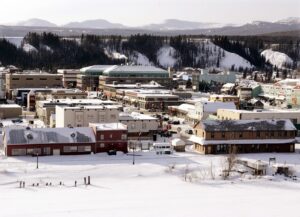
Representatives from all three Canadian territories say the need to improve their aging electricity grids has reached a critical level requiring billions of dollars from the federal government to update, and in some cases, keep the lights on.
Yukon’s energy minister says the need is “no longer theoretical” after a frigid week in December nearly required rolling blackouts in Whitehorse.
Temperatures nearing -50 C saw demand hit 90 per cent of what could be generated, at a time outside of peak hours, Ted Laking said.
Industrial consumers like mines were already disconnected and officials with the city and the territory were trying to decide what could go next.
In the end, the blackouts weren’t required, but Laking said the experience was a sign of problems on the horizon.
“We don’t have time to sit around and hypothesize about these things. It’s no longer theoretical. It is a real and serious risk for the North,” he said.
The Yukon’s power struggles are not unique.
Those in the territories describe aging infrastructure being pushed well beyond its life cycle and a tax base too small to cover the cost of critical improvements at a time when Prime Minister Mark Carney has promised a new national electricity strategy.
Last month, Laking sent a letter to federal Energy Minister Tim Hodgson warning that without immediate investment in new generation and transmission infrastructure, several exploration and development projects in the territory “will either be delayed or rendered uneconomic due to lack of affordable, reliable power.”
“To keep up with expected demand, we anticipate an additional $1.025 billion is required for critical remediation work, increased generation capacity and to support Arctic sovereignty objectives,” the letter said.
Laking said in an interview that while there is aging infrastructure across Canada, supply chain challenges put the North in a unique position.
“We’re further away from large centres, we are further away from port infrastructure. So, what we see is significant increases in the cost of doing business just to do with supply and shipping,” he said.
“But the other unique aspect is labour. Combined, the territories are smaller than many small-sized cities in the country. And that’s a population spread out over 40 per cent of Canada’s land mass.”
The largest piece of the Yukon’s $1-billion wish list is an estimated $520 million to build two new thermal power centres and the required infrastructure in Whitehorse, offering up to 150 megawatts through a mix of LNG and diesel.
“This is really to meet our existing needs but also our projected needs over the next five to 10 years,” Laking said.
“Even with the context of how close we were to the brink in December, we estimate that the demand in the Yukon is going to increase by another 40 megawatts in just five years. So that would put us over what we can actually currently generate. And so we need to move on these things really quickly.”
He said the territory is hoping to have the first phase of the Whitehorse project completed by 2027.
Other needs include improvements to hydro facilities built in the ’60s and a pitch for the federal government to support a hydro expansion in Atlin, B.C., that would feed into the Yukon grid.
Laking said they are hoping for “as much federal funding as possible,” adding that it would be unreasonable to put the cost on the backs of the Yukon’s approximately 19,000 ratepayers.
“Many of these projects actually have a nation-building component. They’re required for us to be able to live here in the North, to grow the North, to meet our Arctic sovereignty objectives, but also to help power industrial customers such as mines,” he said.
‘NOT AN INCONVENIENCE, IT’S AN EMERGENCY’
Ernest Douglas, president of the Qulliq Energy Corp. in Nunavut, said the territory has requested $987 million from the federal government to build six new scalable, modular, hybrid power plants.
Each of Nunavut’s 25 communities is powered on its own diesel-run system that is typically designed to last 40 years, he said. Ten have already exceeded that with the oldest, in Cambridge Bay, being 59 years old.
“If we lose one of these power plants because it’s not functioning properly, then that community becomes a state of emergency, especially this time of year,” he said.
“It’s not an inconvenience, it’s an emergency. So then we’re talking about relocating an entire community. The logistics of that are mind-boggling. So these are things that keep us up at night.”
Douglas said the new plants would continue to run on diesel but have the ability to integrate renewable energy “when and where it is available.”
Carney has promised a national electricity strategy “to provide clean, affordable and reliable power to Canadians,” but details of the plan have not been released.
Earlier this month, he announced $32 billion for northern defence projects including military forward operating locations in Yellowknife, Inuvik and Iqaluit.
Douglas said the territory made its request for funding before the defence plans were announced.
“Our projections do not include defence spending or activities in the North by the Department of National Defence,” he said.
Multiple electricity generation projects in the North have been referred to the federal major projects office for further assessment and accelerated approval.
The includes the Iqaluit Nukkiksautiit Hydro Project, a proposed 15-to-30-megawatt hydroelectric facility 60 kilometres outside of Iqaluit that could potentially remove the need for diesel generation from the city completely.
Douglas said the project is being led by the regional Inuit association and is not part of the energy corporation’s funding ask, but that the corporation is prepared to “purchase every drop of energy that we can get from them.”
Federal major project officials are also looking at the Taltson Hydro Expansion Project in the Great Slave Lake region of the Northwest Territories.
Cory Strang, CEO of the Northwest Territories Power Corp., said the 60-megawatt hydro facility and the transmission lines to connect the Northwest Territories’ two current power grids will cost “billions” but provide options for mines and customers that aren’t available with the current facility, which was built in the ’60s.
“There’s lots of lithium mining. There’s some old gold mining in that area. So once you get the power to that, then you can create a whole bunch of different opportunities,” he said.
Eight of the territory’s 33 communities are currently on one of two power grids while the others each run on their own “micro grid.”
Strang said when individual grids go down, the territory is forced to rely on diesel.
“It’s not like southern parts of Canada where you have big generation facilities, hydro, nuclear, wind, that are all connected with a web of grids or transmission and distribution lines. It’s all isolated,” he said.
Strang said he understands why Canadians in urban centres might question spending billions on a total population of fewer than 140,000 people across three territories.
He said the economic drivers make the money a good investment for the growth of the country as mining opportunities become available and the Northwest Passage opens up for more transportation of goods.
“If you want to move the country forward and really make your name with your colleagues in the world, investment in the North is definitely worthwhile for the rest of Canada.”
This report by The Canadian Press was first published March 25, 2026.
Ashley Joannou, The Canadian Press