OTTAWA — Canada spent $63.4 billion on national defence in 2025, meeting its NATO commitment to spend two per cent of GDP on defence for the first time, the alliance’s annual report said Thursday.
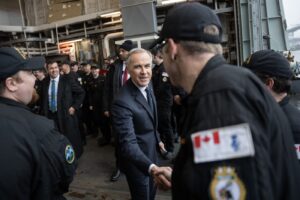
Speaking at an event in Halifax, N.S., on Thursday, Prime Minister Mark Carney called it the “single largest year-on-year increase in defence investment in generations.”
Some details of the Carney government’s defence spending spree won’t be public until it publishes its full accounts for the year in the fall. Here’s a closer look at where some of that money is going:
— The government added $9 billion to the fiscal framework in summer 2025 to help meet the NATO spending target. That included $2.6 billion for recruitment and retention and nearly $1 billion for maintaining infrastructure and equipment.
— Ottawa ordered a major salary hike for members of the Canadian Armed Forces, with some members receiving pay bumps as high as 20 per cent. That was part of that $9 billion sum, although the government did not provide a detailed cost breakdown for the pay raise.
— As part of a flurry of announcements in March, Ottawa announced $200 million for a space launch pad in Nova Scotia to send satellites into orbit.
— The government recently set aside $1.4 billion for producing munitions in Canada, such as 155mm artillery shells. Of that sum, $356 million is going toward setting up a factory in Quebec to make nitrocellulose, an ingredient used as a propellant in artillery shells.
— $307 million is going to Colt Canada for new modular assault rifles to replace army rifles and carbines that are more than 35 years old.
— $753 million went to Bombardier for a fleet of Global 6500 VIP jets.
— The Treasury Board said in February, close to the deadline for the fiscal year, that National Defence needed “$1 billion to cover urgent and unforeseen defence requirements.” It did not explain why the funds were urgently needed.
In a recent interview, Defence Minister David McGuinty said to speed up the process, a lot of the spending was broken down into small projects — such as one to expand Wi-Fi access at military bases and another to overhaul the bases’ water and wastewater systems. He did not say exactly much each project would cost.
As the government moves at breakneck speed to get money out the door, some details on how military contracts and various funding programs break down have become hard to come by.
NATO’s annual report only provides top-line figures from its accounting information, which comes from NATO partner nations themselves. In Canada’s case the figures are still estimates, since Canada’s fiscal year has not yet ended.
Canada also has committed to spending five per cent of GDP on defence by 2035.
That five per cent figure is somewhat deceptive, since just 3.5 per cent of that will go to core defence needs, while 1.5 per cent is to cover spending loosely related to national security — such as funding for maritime ports, airports and other infrastructure.
The federal government maintains Canada is already spending 1.5 per cent on defence-adjacent items, which includes municipal and provincial spending.
This report by The Canadian Press was first published March 26, 2026.
The Canadian Press