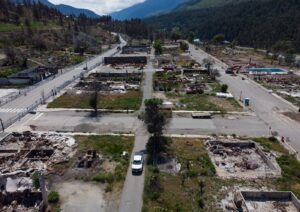
A report from the office of British Columbia’s auditor general says the province expected the Village of Lytton to lead its own recovery from the fast-moving wildfire that destroyed most of the community and killed two people in June 2021.
But it says officials with the village in B.C.’s southern Interior were “immediately overwhelmed by the magnitude of devastation” wrought by the fire and lacked the necessary staff and funds, prompting the province to step in.
Still, the auditor’s report says the B.C. government itself didn’t have a comprehensive legal framework to guide disaster recovery at the time.
It says B.C.’s legislation and policies in 2021 were “not sufficient to guide the complex and unprecedented recovery of a whole community.”
The auditor’s report also says B.C.’s Emergency Program Act was “silent” on the role of Indigenous Peoples at the time of the fire, and the lack of collaboration between the village and Nlaka’pamux governing bodies was a “missed opportunity.”
The report released Tuesday notes the B.C. government has since passed new emergency and disaster management legislation, including requirements for local authorities to work with Indigenous governments on emergency plans.
Premier David Eby says the new law requires conversations between local governments and First Nations to happen before a potential emergency, marking a shift from how things were done before the fire that swept through Lytton.
“This hopefully will be just one of the many improvements that have come about, hard lessons learned through … the terrible loss of property that took place in Lytton following that devastating fire,” Eby told an unrelated news conference.
Eby says the province would respond to the auditor’s report later Tuesday.
The auditor’s report says the community lost its grocery store, bank, post office, school, health centre and electrical infrastructure in the blaze, along with dozens of homes and “nearly all” municipal records, including building and planning bylaws.
After the flames subsided, it says the land was covered in debris and contaminated by soot and ash containing asbestos and heavy metals, including lead.
The report says archeological work in the rebuilding process following the deadly and destructive blaze was a “significant source of tension,” which the province “could not mitigate,” despite providing funds to the village to help offset the costs.
The auditor’s report says B.C. initially provided money directly to the village to support its recovery, but after receiving incomplete spending and progress reports, it shifted to a reimbursement-based funding model set to end in 2027.
In total, the province distributed more than $51 million to the village over the auditor’s examination period between June 30, 2021 and March 2025.
The report identifies issues for the province to consider as it implements the new disaster management law, including anticipating recovery in communities with low cash reserves, agreements with Indigenous governments and developing a framework for assessing communities’ capacity to lead their own recovery.
The review was prompted by concerns raised by the public and members of the B.C. legislature about the progress and cost of recovery, the report notes.
This report by The Canadian Press was first published March 17, 2026.
The Canadian Press