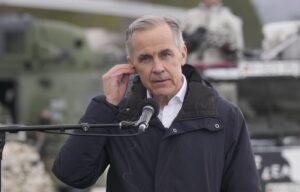
OTTAWA — If one thing is clear a year into his tenure, it’s that Mark Carney is running the federal government very differently from the way Justin Trudeau did it.
Much of Ottawa’s chattering class has settled on describing the former central banker as a CEO-style leader who wants to run the country like a Fortune 500 company, and makes little time for consulting while he races to implement his economic agenda.
Still, when The Canadian Press asked the prime minister on his way into cabinet on Thursday if he was satisfied with the pace of that agenda, he replied it “could always go faster.”
Carney got a boost in the 2025 election from comedian Mike Myers and his rallying cry of “elbows up” against U.S. President Donald Trump.
Conservative Leader Pierre Poilievre has since used the mantra as a foil, contending Carney’s elbows are down — or missing entirely — with U.S. tariffs still firmly locked in place.
A year later, it turns out the public wasn’t looking for a donnybrook with the Americans.
“It’s like they want one elbow up and one elbow down,” said Abacus Data CEO David Coletto, who published this week a batch of polling and analysis on where Carney stands with the public after his first year in office.
“Canadians overwhelmingly remain deeply unhappy. Some feel betrayed, some even may be more aggressive in their feelings towards the United States, and particularly the president, and want Canada to stand up to the United States even if it means some economic pain,” Coletto said.
“Those same people also understand how complicated and difficult it is to deal with Trump, and so they’ve given the prime minister some leeway to navigate that, given what he is trying to achieve, trying to salvage the CUSMA free trade deal and keep the relationship at least strong enough that we can continue to do business with our largest trading partner.”
Threading that needle appears to be paying off. Recent polls by several firms have Carney’s Liberals soaring in the high 40s — majority government territory.
Coletto said the public sees a clear break from the last Liberal administration in Ottawa, with no signs of regret among Carney voters — and with many who did not vote for him saying he’s doing a good job.
The party has done a full 180, pivoting from a strong focus on social equity to a preoccupation with shoring up the economy, pushing for major infrastructure developments and ramping up military spending to Cold War levels.
Carney quickly dispensed with some key Trudeau-era policies, ending the controversial consumer carbon tax and doing away with the digital services tax — a major trade irritant for the U.S.
Compared to other recent prime ministers during their first years in office, Carney has spent an extraordinary amount of time travelling the world to meet with international leaders and blue chip CEOs.
Lori Turnbull, a political-science professor at Dalhousie University, said some of Carney’s most notable accomplishments stem from that push to diversify trade. He’s given a new lease on life to Canada’s relationship with India, warmed relations with China and opened new paths with Japan, Malaysia and others.
His January speech in Davos, Switzerland at the World Economic Forum making the case for middle powers to band together has registered far and wide.
“That was significant for him. It was a speech, I know, but it still had the effect of Canada showing up differently on the world stage and giving Carney the credit for that,” Turnbull said.
The prime minister also has reset federal-provincial relations — another stark contrast with Trudeau, who frustrated the Prairie provincial governments that are now reaching out to Carney.
He extended an olive branch to Alberta Premier Danielle Smith and landed an agreement with her on building an oil pipeline out to the B.C. coast — just as a separatist movement in the province began making headlines. He won praise from Saskatchewan Premier Scott Moe for resolving a canola industry crisis.
While Trudeau was criticized for expanding the public service, Carney has set to work trimming it and installing corporate outsiders.
He’s brought private-sector talent — such as Doug Guzman and Dawn Farrell — into key roles on priority files with aggressive mandates, and appointed investment manager Mark Wiseman as ambassador to the U.S.
Carney spends very little time explaining his agenda to Canadian journalists one-on-one and his cabinet ministers have scaled back the amount of time they spend speaking with reporters. The Prime Minister’s Office has not granted The Canadian Press, Canada’s oldest news agency, an interview with Carney since before the leadership race.
The much-travelled prime minister has spent a modest amount of time in the House so far this year and sometimes skips caucus meetings.
He has leveraged omnibus bills — but his legislative track record is thin. He’s turned nine government bills into law. They include the economic legislation at the heart of his push to build more major industrial projects, the One Canadian Economy Act.
Carney described the bill last fall as the “most comprehensive and, what will be seen in the fullness of time, impactful economic measure in decades.”
Turnbull said the jury is still out on the success of his efforts to build major infrastructure projects.
Poilievre contends he’s going about it the wrong way.
“Canada is in the weakest position a year after Mark Carney,” Poilievre said Friday in Windsor, Ont.
“He promised that he would move quickly to build projects, yet he has not yet given the green light to a single pipeline, his special projects office has not approved a project of any kind and of course he’s not removed a single anti-development Liberal law.”
Carney has in just the past four months dealt his opponents a series of psychological blows in the House by poaching their colleagues, turning four MPs from the Conservative and New Democrat caucuses into Liberals.
NDP interim leader Don Davies said this week he’s “increasingly concerned” by the way Carney is “trying to stitch together a majority government” through “backroom deals” instead of at the ballot box.
That could soon be settled in the coming weeks through three April byelections, two of which are considered safe Liberal seats. Winning two seats would technically get Carney a majority but sweeping all three would allow him to govern effectively with one.
Green Party Leader Elizabeth May said Canadians now have the corporate-style leader they wanted to deal with Trump. But Carney still faces a steep learning curve when it comes to consulting before pressing ahead, she said.
“I can’t begin to imagine how much worse it will be if he ever gets that last floor-crosser or finally gets to a majority government, because a minority Parliament with Mark Carney as prime minister has been extremely top-down and bulldozing toward whatever the goal of the moment is,” she said Thursday.
“I haven’t seen anything stand in his way for more than a nanosecond.”
Coletto said that if a Liberal majority does come together, it will produce a new challenge for Carney: keeping this diverse party united.
“He’s brought a very large group of people together who wouldn’t otherwise probably agree on much,” he said, noting the caucus is now packed with Trudeau Liberals, former Tories and a former NDP MP.
Turnbull said this would also introduce a new question for the Conservatives — whether they need a new leader.
“If Carney gets his majority, that’s very bad news for Poilievre because it means that the government is on track to last … a while,” she said. “Which means that the Conservatives have to start thinking about, do they want to go to election with Poilievre?”
This report by The Canadian Press was first published March 14, 2026.
Kyle Duggan, The Canadian Press