EDMONTON — Alberta’s new budget will carry an eye-popping $9.4-billion deficit as the province, after decades of trying to get off a roller-coaster of oil revenues, seeks to manage the ride and weather the whiplash.
The deficit is the largest since the COVID-19 era, a time of global economic catastrophe that saw oil prices trade in negative numbers.
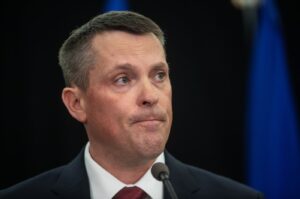
Finance Minister Nate Horner says the costs of a rising population coupled with global uncertainty and low oil prices are hammering the province’s bottom line and stretching capacity.
But he says now isn’t the time to ratchet back spending on core services. The budget will see spending increases in health and education. There are no new major taxes but there is a new tax on car rentals, and hikes to things like property taxes and vehicle registration costs.
“Our balance sheet is in better condition than that of many Albertan households, so we’re going to weather this for them,” Horner told reporters Thursday before introducing the budget in the house.
The province projects West Texas Intermediate – the lifeblood benchmark oil price for Alberta’s economy — to average US$60.50 a barrel in the upcoming fiscal year — not nearly enough to balance the books.
Horner said if oil prices stay low indefinitely, the structural deficit will become “extremely obvious.” But he said he doesn’t have a mandate right now to tinker with tax reform.
Alberta doesn’t have a provincial sales tax and has comparatively low business and personal taxes.
Earlier this week, Horner said a five per cent provincial sales tax in an economy like Alberta’s could drive about $6 billion in revenue, but he’s not promoting a referendum on a potential PST “right now.”
“We’ve got to take Albertans with us on this ride,” he said Thursday.
The budget estimates that Alberta’s current tax structure saves businesses and individuals about $17 billion — if not more — when compared with tax rates in other provinces.
“If Albertans want to give up some of that advantage to get off the roller-coaster, that’s a conversation we can have,” Horner said.
The deficit also breaks a threshold for going into the red legislated by Premier Danielle Smith’s United Conservatives. When asked what the consequences are for blowing past the government’s own fiscal guardrails, Horner said the consequences are “political.”
“We created these rules, and I’m breaking them. So it bothers nobody more than it does me.”
While Horner acknowledged population growth is slowing, he said the province still needs to “catch up” to demands in infrastructure, including hospitals and schools.
Health-care spending is going up almost six per cent, or $1.9 billion, bringing it to $34.4 billion. Education funding is rising by seven per cent from the previous year, for a total of $10.8 billion.
The changes come as pressures on emergency rooms have sparked stories of suffering and potentially preventable deaths, and after teachers were ordered back to work in the fall amid a rancorous strike in which they demanded action on overcrowding and complex classrooms.
As the budget looks forward to 2028-29, there’s no projected balance on the horizon.
Opposition NDP Leader Naheed Nenshi said the budget shows the UCP has mismanaged the province’s finances, broken its own rules, and lost the moral authority to govern.
He said the budget, despite record levels of oil production, makes the cost of living more expensive with a string of new fees while failing to solve fundamental problems in health care and education.
And to top it off, he said, “Danielle Smith and the UCP have saddled future generations, our kids and our grandkids, with billions and billions of dollars in debt with no path to balance.”
Smith’s government is also aiming to grow the nest egg Alberta Heritage Savings Trust Fund. It is expected to grow to about $34 billion by the end of 2026-27.
This is the second deficit in a row from the UCP, after the province racked up an $8.3 billion surplus in 2024-25. For the current fiscal year ending in March, the province is forecasting a $4.1-billion deficit.
Taxpayer-supported debt is now expected to soar to $109 billion in the province with a population of five million.
Smith has said Alberta is under strain as more people arrive in the province — but those numbers are levelling off.
Population growth is expected to slow significantly in 2026-27, and government officials say the province is seeing net outflows of non-permanent residents.
Oil prices for decades have been both a golden goose and an albatross for Alberta. Successive governments have promised to try to diversify the economy to avoid reliance on steep swings in revenue tied to oil prices.
As recently as last year’s throne speech, Smith’s government indicated that oil is — and will remain — the key driver.
“The vast majority of Albertans do not want deep and disruptive cuts, nor do they want declarations of economic emergency used as a pretext for a proliferation of government programs and spending,” Lt.-Gov. Salma Lakhani told the house at the time.
“They want calm, steady and smart fiscal leadership until the dip in energy prices inevitably passes — as it always does.”
This report by The Canadian Press was first published Feb. 26, 2026.
— With files from Aaron Sousa
Lisa Johnson and Jack Farrell, The Canadian Press