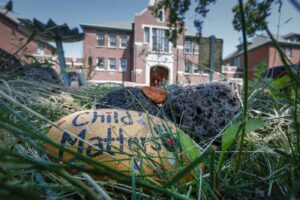
KAMLOOPS — The British Columbia First Nation that announced the discovery of 215 potential unmarked graves at a former residential school in 2021, catapulting the issue into public discourse, says there may never be consensus on what to do with the site.
A statement from the Tk’emlups te Secwepemc First Nation says possible future outcomes for the Kamloops Indian Residential School property include excavation or preserving its orchard as a sacred site, “a place of memory and healing.”
The nation says its investigation is ongoing, with the findings so far pointing to several areas of focus, with “signatures that resemble burials” identified in some, and other areas ruled out as burial sites.
Tuesday’s statement says more than 500 children from 38 Indigenous nations living in 119 B.C. communities attended the institution at its peak, and the nation must seek consensus on how ancestral remains should be treated.
Still, it says “we also understand that full consensus may never be achieved.”
The nation says any remains would need to be repatriated in their home communities, calling it an “extremely complex and sensitive process” involving consultation with those nations, DNA analysis and forensic expertise.
Whether to dig at the site has been a fraught question, with no agreement among survivors of the institution. Some have said they see exhumation as a process to help lay victims to rest, while others don’t want the site disturbed.
In 2022, a year after the initial announcement of the discovery of suspected unmarked graves, Tk’emlups Chief Rosanne Casimir described the nation’s approach as an ongoing process of “exhumation to memorialization.”
The probe has included the use of ground-penetrating radar, LIDAR scanning and specially trained dogs, along with the examination of records from the Catholic Church and the B.C. and federal governments, said the statement this week.
“While the investigation has been more complex than we initially thought, we are making progress and will continue adapting our methodologies and information as it advances,” it said.
A report by the National Truth and Reconciliation Commission in 2015 detailed harsh mistreatment at residential institutions across Canada, including emotional, physical and sexual abuse of children, and at least 4,100 deaths.
The report cited records of at least 51 children dying at the Kamloops school between 1914 and 1963. Health officials in 1918 believed children at the school were not being adequately fed, leading to malnutrition, the report noted.
The Kamloops institution operated between 1890 and 1969, when Ottawa took control from the Catholic Church and ran it as a day school until it closed in 1978.
This report by The Canadian Press was first published Feb. 18, 2026.
The Canadian Press