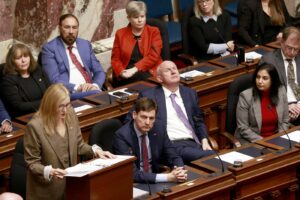
VICTORIA — No wonder British Columbia Finance Minister Brenda Bailey thought she was going to be “the least popular person in the province.”
She tabled a budget Tuesday that boosts taxes, delays projects for the old, the young and cancer patients, while failing to rein in the deficit as previously pledged.
Instead, it brings in a record deficit of $13.3 billion.
“They definitely seemed to manage to piss off everybody,” Marc Lee, senior economist with the Canadian Centre for Policy Alternatives, said.
Bailey, who was tabling her second budget, unveiled a budget she called “serious work for serious times” that raises the base income tax rate for the first time in a generation.
“It’s our time to take a pause on some of the things we want to do, to do the things that we need to do,” she said.
The tax rate on the lowest bracket will increase by 0.54 per cent, with government staff saying 60 per cent of tax filers will face higher bills, and the average taxpayer will be hit with a $76 hike.
The budget says increasing the bottom tax rate to 5.6 per cent means a maximum impact of $201 on people earning more than $140,000 without additional credits, while credits for some lower earners are being raised.
B.C. has not increased the tax rate on the lowest bracket in more than a quarter century when the province moved to a “tax on income” system in 2000. Before then, provincial tax was based on a percentage of federal tax.
The budget also raises more money by applying the provincial sales tax to some professional services and ending exemptions elsewhere.
Government will also stop indexing tax brackets from 2027 to 2030, that could push some earners into higher tax brackets.
The changes in revenue are still not enough to stop the deficit from rising. It is projected to spike by 38 per cent to a record $13.3 billion next fiscal year, compared with an updated forecast for the current year of $9.6 billion.
Taxpayer-supported debt is projected to rise from $142.8 billion in 2026 to almost $190 billion in 2028.
Peter Milobar, B.C. Conservative Party finance critic, said the changes are going to hurt hard-working families, seniors and small businesses.
“This government has chosen very clearly to not get their spending under control, to watch debt-servicing costs skyrocket,” he said. “Instead, they have to start reaching into seniors and hard working families’ pockets and small businesses pockets to try to pay that bill.”
B.C. Green Party house Leader Rob Botterell said they are “deeply disappointed” with the budget.
“Maintaining the status quo is insufficient,” he said. “The status quo is closed ERs, schools without resources, inequality growing by the day.”
David Williams, vice-president of policy with the Business Council of British Columbia, says B.C.’s finances are not sustainable.
“This budget doesn’t really change that trajectory, unfortunately,” he said.
Construction of long-term care facilities, student housing and Burnaby’s hospital and cancer facility are being delayed to curtail costs.
Seniors Advocate Dan Levitt said the decision will add strain to the health care system and private households.
“It’s going to put pressure on the family caregivers, people who should be in the workforce, who are now caring for that senior,” he said. “(It’s) also going to create a situation where the seniors are not getting the kind of care they should be.”
Bailey’s budget speech says she is delivering the plan with a “heavy heart” after the “horrific tragedy” of last week’s mass shootings in Tumbler Ridge, B.C. Nine people, including the killer, died on Feb. 10 at the local high school and a private home.
The minister said the budget implements “disciplined measures,” including a “leaner” public sector that is forecast to shrink by 15,000 full-time employees over the three-year fiscal plan.
While the deficit is forecast to increase $3.7 billion year on year, Bailey said a “guiding principle” was that the deficit would decrease “over time,” with the ongoing impact of structural changes, such as the tax increase and public sector cuts.
“Nobody worries about the deficit more than I do,” she told reporters, adding that “nothing could be further from the truth” than that she had given up trying to cut the deficit.
Paul Finch, president of the BC General Employees Union, said he hopes that government follows through on its promise to “rightsize” the ratio of managers to front-line service workers.
“That has gotten completely out of whack over the past decade-and-a-half,” he said.
Finch said the union is concerned about the budget.
“Any cut to front-line services, any cut to unionized employees, that provide critical services to British Columbians, is not just going to hurt people who need those services right now, it is also going to hurt the economy,” he said.
Shannon Salter, deputy minister to Premier David Eby, said in a recent email that the deficit was “unsustainable.”
Bailey said B.C. would continue to have the lowest income taxes of any province for people earning less than $149,000, while 40 per cent of taxpayers will see a tax saving in 2026 and the lowest earners “will come out ahead.”
She said the budget was not about “new, shiny programs.”
Capital spending is being wound back to $18.7 billion next fiscal year compared with the previous forecast of $20.4 billion, and it is projected to keep falling to $16.1 billion by the 2028 fiscal year.
Bailey said that would involve “re-pacing” construction of several long-term care facilities, Phase 2 of Burnaby’s redeveloped hospital and student housing at the University of Victoria.
“These are not cancellations, this is a recognition that the province needs to strategically resequence projects to address fiscal pressures,” she told reporters.
This report by The Canadian Press was first published Feb. 17, 2026.
Wolfgang Depner, The Canadian Press