OTTAWA — Major airlines are claiming the initial findings of a federal probe clear their industry of allegations of unpaid work, but Jobs Minister Patty Hajdu says investigators need more data before the issue is settled.
On Thursday, the federal government published the initial findings of a probe it launched six months earlier into allegations made during collective bargaining between Air Canada and the union representing its flight attendants.
More than 10,000 Air Canada flight attendants went on strike in August 2025.
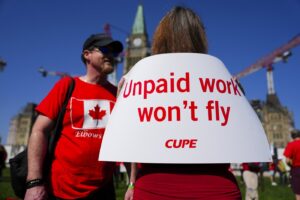
Central to that labour dispute were claims from the Air Canada component of the Canadian Union of Public Employees that flight attendants were not being paid for some work, such as ground duties.
Employers in federally regulated industries like the airline sector must compensate employees at or above a bar set by the federal minimum wage.
Hajdu’s department said the first phase of its probe did not find evidence that compensation practices in the airline sector fall short of the federal minimum wage set out in the Labour Code.
But its report did flag that compensation practices for many part-time and entry-level flight attendants warranted “closer examination.”
In an interview with The Canadian Press, Hajdu said federal investigators heard stories from union members about times when they weren’t fully compensated for delayed flights. She said those anecdotes couldn’t be fully verified by pay records.
“That’s not to say it isn’t true. That’s just to say that the records aren’t matching,” Hajdu said.
“We just didn’t get sufficient information to really fully determine, one way or another, the validity of the argument.”
Hajdu said investigators found one example in a small northern airline “where it looked like people were being underpaid.” She said the unnamed employer is working with her department on fixing that gap.
In a media statement, CUPE said that it was disappointed the probe “appears to have concluded that the abuse of unpaid work by multi-billion dollar airlines is not a problem worth fixing.”
The report said compensation for flight attendants across most of the airline industry is covered by the “credit-based model.”
Rather than an hourly pay rate, the credit model calculates time spent in the air alongside per diems and other benefits that top up a flight attendant’s total compensation.
Hajdu said while it’s fair to look at whether this system is still working as intended, it’s a model most unions and airlines have agreed to over the course of decades of collective bargaining in Canada.
The federal government is asking airlines to self-audit their pay records to ensure all flight attendants are paid in accordance with the Labour Code.
Wesley Lesosky, president of CUPE’s airline division, said in a statement Thursday that Ottawa is putting “blind faith” in airlines’ willingness to act responsibly.
“If airlines could be trusted to do the right thing, we wouldn’t be where we are today, but that’s the only remedy the government has offered so far,” Lesosky said.
Hajdu said the federal government is taking a “collaborative” approach with unions and airlines but is prepared to order records or impose penalties if either party doesn’t live up to its side of the bargain.
“The next step, if they don’t comply, is that we will order them to,” she said.
Air Canada vice-president of corporate communications Christophe Hennebelle said in an email that the airline welcomes the outcome of the federal government’s investigation and said it confirmed “there is no unpaid work at Air Canada.”
“The findings confirm that the credit‑based pay structure is compliant with the (Labour) Code, and that the compensation framework for flight attendants across the airline industry meets the Code’s standards,” Hennebelle said.
Air Canada will “fully participate” in future phases of the probe, Hennebelle added.
The National Airlines Council of Canada, which represents Air Canada, Air Transat, Jazz Aviation and WestJet, said in a media statement the investigation “did not identify any systemic action on the part of airlines to avoid compensating flight attendants for the work they perform.”
The organization added that its members are “proud of the vital role flight attendants play” and “remain steadfast in supporting compensation systems that reflect the importance of their work.”
Porter Airlines director of communications and public affairs Brad Cicero said in an email that the Toronto-based carrier takes Ottawa’s probe as affirmation the credit-based compensation system is “appropriate.”
Air Canada and the flight attendants’ union started an arbitration process last month to settle outstanding wage issues.
The tentative deal that ended the August strike would have increased wages for workers and established a pay structure for time worked when aircraft are on the ground.
Hennebelle said the contract offer “includes industry‑leading provisions that specifically recognize and compensate ground duties” and “directly address the misperception of unpaid labour among flight attendants.”
Union members overwhelmingly rejected that tentative deal in a September vote, but the parties reached agreements on other key parts of the contract and agreed not to initiate work stoppages while the wage issue is being ironed out.
Lesosky warned that unpaid work will be a “central issue” as airlines, including WestJet and Porter, sit down to bargain with flight attendants this year. He chastised the federal government for performing a series of studies instead of taking action.
Hajdu said the federal government will be paying close attention to the outcome of those talks between Air Canada, the union and the Canada Industrial Relations Board. She said she expects clarity on wage requirements will lead to better relationships between labour and employers in the sector.
“I think the CIRB will help both the union and Air Canada sort through the appropriate regime for compensation through their deliberations and we’ll be looking very closely at what the decision of the board is and how that unfolds,” Hajdu said.
The head of enforcement and compliance at Hajdu’s department is expected to gather airline and union representatives in Ottawa later this month for a meeting to review the minimum wage requirements in detail.
This report by The Canadian Press was first published Feb. 12, 2025.
Craig Lord, The Canadian Press