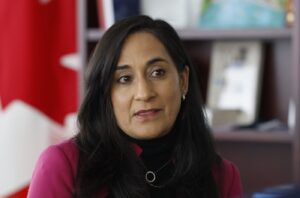
WASHINGTON — Foreign Affairs Minister Anita Anand was in Washington on Wednesday as the Trump administration made a case for international partners to join a preferential trade zone for critical minerals to counter China’s global dominance.
Vice-President JD Vance told a room filled with foreign ministers and officials at the U.S. State Department the goal is to diversify “global supply in the critical minerals market while strengthening the partner countries who help all of us in the shared effort.”
“We are all on the same team,” Vance said.
Ending China’s stranglehold on critical minerals became a key U.S. priority last year after U.S. President Donald Trump escalated his trade war between the world’s two largest economies by imposing massive tariffs. Beijing responded with retaliatory duties and export restrictions on various critical mineral exports to the U.S., causing anxiety throughout supply chains.
Vance said the United States will establish reference prices for critical materials at each stage of production that reflect “real world fair market value.”
“And for members of the preferential zone, these reference prices will operate as a floor maintained through adjustable tariffs to uphold pricing integrity,” he said.
Vance said countries that join would secure access to “the critical mineral supplies” they “would require in an emergency or some other contingency.”
U.S. Secretary of State Marco Rubio told the assembled foreign officials “everyone here has a role to play” and an international effort would be essential for success.
But the Trump administration’s push to secure access to critical minerals abroad comes as it continues to undermine multilateral institutions and rattle old allies with tariffs and threats of annexation.
Trump’s obsession with acquiring Greenland infuriated European countries and put into question the future of NATO. Greenland and Denmark did not have representatives at Wednesday’s meeting.
The Trump administration already has signed critical mineral agreements with several countries, including Australia and Japan. Additional deals with the European Union and Mexico were also announced Wednesday.
The international gathering is taking place after Trump announced Monday the launch of “Project Vault,” a strategic reserve for rare earth elements.
While the United States does have reserves for defence purposes, the Trump administration said the new reserve would help shield makers of autos, electronics and other goods from supply chain disruptions.
The reserve is to be funded initially by a $10 billion loan from the U.S. Export-Import Bank and nearly $1.67 billion in private capital.
It’s not clear what the Trump administration would want from Canada in any critical mineral agreement.
Under Canada’s leadership last year, the G7 launched a critical minerals action plan that has parallels to Wednesday’s announcement.
Canadian officials have made collaboration on critical minerals a talking point with their counterparts in Washington as they lay the groundwork for a mandatory review of the Canada-U.S.-Mexico agreement on trade later this year.
Canada and the U.S. Department of Defense already have a co-investment deal to accelerate Canadian mining development and strengthen critical minerals supply chains.
On the issue of critical minerals, Canada is working at the G7 level but also bilaterally with multiple countries, including the U.S., said Rachel Ziemba, founder of Ziemba Insights and adjunct senior fellow at the Center for a New American Security.
In an email, Ziemba said that while there are many unanswered questions about the Trump administration’s plans, it appears the United States is focused on rare earths, rather than other critical minerals, which may make it easier to get an agreement with Canada.
Critical minerals are a broad category, while rare earths are 17 elements used in key industries like electronics. Canada has some of the largest known reserves of rare earth metals globally — but China is by far the largest producer and refiner.
“Canada isn’t processing any rare earths at this point, but the policy would aim to set common standards for support, eventually use tariffs to block resources from any countries that don’t align,” Ziemba said.
“However, the big issue now is that China is really the dominant player and just imposing tariffs isn’t going to solve the problem as China can just impose its export controls.”
This report by The Canadian Press was first published Feb. 4, 2026.
— With files from The Associated Press
Kelly Geraldine Malone, The Canadian Press