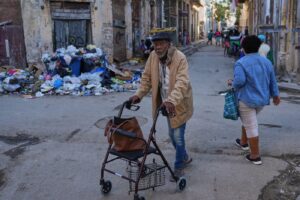
OTTAWA — As Canada warns travellers of food and electricity shortages in Cuba, experts say any move by the U.S. to overthrow the island’s communist leadership would put Canada in a bind much worse than the aftermath of the American armed intervention in Venezuela.
Two former ambassadors say they’re confident Global Affairs Canada is preparing contingency plans for responding to the various ways in which Washington could intervene in Cuba.
They also say Canada’s response could be shaped by Ottawa’s need to secure a renewed trade deal with the U.S.
“Canada, more than probably any other nation, is caught in a vise grip,” said Mark Entwistle, who was Canada’s envoy to Havana from 1993 to 1997.
For more than a year, Global Affairs Canada has warned travellers of “shortages of basic necessities, including food, medicine and fuel” across most of Cuba. The department had been exempting some major resort areas from that warning until mid-January.
The department wrote on social media that Cuba has grappled with rolling blackouts since October 2024.
U.S. President Donald Trump ordered a military raid on the Venezuelan capital earlier this month, capturing President Nicolas Maduro and claiming authority over that country’s oil supply.
That operation happened after Washington released a new national security strategy that calls for the U.S. to exert much more control over North and South America.
Some within the Trump administration, such as Secretary of State Marco Rubio, have long called for regime change in Cuba, where the communist government has faced decades of steep American sanctions.
After Maduro was captured, Rubio said Cuba’s government should worry about what the U.S. might do next.
“There is a plausible possibility that the United States will take even further drastic action in an attempt to bring down Cuba while they can,” said Entwistle, citing the possibility of a naval blockade that could violate international law.
“They are quite convinced, I believe, in Washington now that the end is nigh — that the Cubans cannot possibly survive the shutting off of that Venezuelan oil supply,” he added.
“The Cubans have a tremendous ability to survive.”
Entwistle said Canada would need to consider the status of continental trade deal negotiations before deciding how it would respond to “significant aggression” by the U.S. in Cuba. He said Ottawa likely would consider sending humanitarian aid.
In an interview from Havana, Queen’s University historian Karen Dubinsky said the blackouts are lasting eight to 10 hours and locals believe this is because of American restrictions on Venezuelan oil.
“I’ve been coming here for many years, for decades, and I don’t think that I’ve seen people so dispirited in Havana,” said Dubinsky. “The U.S. actions in Venezuela have had a huge impact here.”
Dubinsky researches people-to-people ties between Canada and Cuba, as well as the politics of music in Cuba. She said the crowds at an ongoing jazz festival have been mostly made up of foreigners, instead the usual mix of tourists and locals taking in shows together.
“That sense of community that culture always had here, that brought people together, foreigners and Cubans, that’s increasingly difficult because there’s so many other pressing problems, like groceries and electricity,” she said.
Dubinsky said Canada is a major partner for Cuba in trade, development work, education and cultural exchanges. She said the Cubans she speaks to want to maintain these decades-long relationships, no matter what the U.S. does next.
“Whatever one thinks about the Cuban government … I would say to Canadians, don’t lose sight of who gets hurt by a blockade. Don’t lose sight of who is suffering — and I do mean suffering — under these constant power blackouts and the tensions of living with the kind of uncertainty,” she said.
Late Thursday, Trump signed an executive order imposing a tariff on any goods from countries that sell or provide oil to Cuba. Mexican President Claudia Sheinbaum says her government has temporarily stopped oil shipments to Cuba, but says it was a “sovereign decision” not made under pressure from the U.S.
Trump has squeezed Mexico to distance itself from the Cuban government, and has said the Cuban government is ready to fall.
Matthew Levin, who was Canada’s ambassador to Cuba from 2010 to 2013, said Cuba’s government is unlikely to collapse because the population is used to scarcity.
But the island is a top spot for Canadian tourists, who may require Ottawa’s consular assistance if major infrastructure collapses or if there is widespread violence.
“I’m sure that consular operations at Global Affairs Canada is preparing scenarios, and I’m sure they’re in contact with the tour operators who are responsible for moving the vast majority of Canadians who go to Cuba,” he said.
Levin said while it’s also unlikely that any U.S. intervention would have a direct impact on resorts, food and fuel shortages are having their effects — despite the Cuban government’s efforts to insulate the lucrative tourism industry.
He argued Cuba has “a very cohesive and kind of hermetic governance mechanism” that would continue largely unchanged if the U.S. removed its president or prime minister.
Levin and Entwistle both said Cuba would be affected by an embargo cutting off access to Venezuelan oil but could still source fuel from Russia and Mexico.
Entwistle said Canada has a “profoundly different” relationship with Cuba than does the U.S., which has pursued regime change since Fidel Castro overthrew a U.S.-backed dictatorship in 1959.
“Along with Mexico, we’re really the only countries in the hemisphere that have had an uninterrupted and steady relationship with the Cubans,” he said.
The Canadian government has described that policy as “constructive engagement,” where Canada permits business relations and personal exchanges in the hopes of encouraging Cuba’s political and economic liberalization.
Global Affairs Canada says Canada is Cuba’s second-largest source of direct investment, particularly in the mining and tourism sectors, which have never fully recovered from the pandemic slump.
That investment persists despite American sanctions and currency regulation, Entwistle said.
Conservative MPs have called for Canada to put more pressure on the communist regime — to advocate for political prisoners and to pressure Cuba to stop sending soldiers to support Russia’s war on Ukraine. Conservative MP Garnett Genuis has branded Cuba “a menace to regional and global security.”
Entwistle said Cuba’s growing private sector is challenging its governing ethos of equality, as elites with money can still access goods most of the population struggles to find.
“What we’re seeing in Cuba is an increasing fragmentation and segmentation of society, which puts further stress on, of course, the revolutionary thesis,” he said.
He said Canada could one day help Cuba transition to a social-democratic model similar to some European states.
“There is a different future for Cuba than just simple collapse, despair and anarchy. And I think it’s in Canada’s interests as a leader in the Americas that we do everything we can to not let that latter scenario play out,” he said.
This report by The Canadian Press was first published Jan. 30, 2026.
— With files from The Associated Press
Dylan Robertson, The Canadian Press