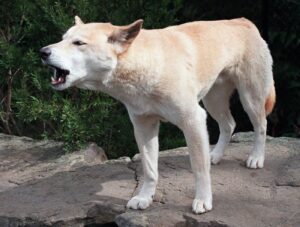
A pack of “aggressive” dingoes involved in the death of 19-year-old Canadian Piper James on an Australian beach is being culled, government officials have announced.
Preliminary autopsy results released on Thursday found that James, from Campbell River, B.C., had been bitten by dingoes both before and after her death on the island of K’gari, in addition to evidence consistent with drowning.
Queensland state’s Ministry of Environment and Tourism said Saturday that rangers had been closely monitoring the pack of dingoes that was circling James’s body when it was discovered early on Jan. 19, and had “observed some aggressive behaviour.”
“Following the initial autopsy findings, this pack’s involvement in the incident, and observations since, this pack has been deemed an unacceptable public safety risk,” the statement said, adding that the dingoes involved would be “humanely euthanized.”
Piper James’s father, Todd James, said in a brief social media post on Saturday that he had been told by Australian police about the cull.
“Simply sad, heart-wrenching information,” he said, noting that a final autopsy report had yet to be issued.
Police have said Piper James ventured out for an early-morning swim on a beach on K’gari, an island off Australia’s east coast.
Her body was found not long after, surrounded and “interfered with” by a pack of about 10 dingoes, a type of wild dog.
Initial autopsy findings suggested dingo bites were likely not James’s immediate cause of death, but noted the presence of “pre-mortem” bites.
“The autopsy has found physical evidence consistent with drowning and injuries consistent with dingo bites,” a statement from the Coroners Court of Queensland said.
“Pre-mortem dingo bite marks are not likely to have caused immediate death. There are extensive post-mortem dingo bite marks.”
Queensland Environment and Tourism Minister Andrew Powell said Saturday that while euthanizing the animals was a tough decision, it’s the “right call.”
“This tragedy has deeply affected Queenslanders and touched the hearts of people around the world,” he said in the ministry’s statement.
The Australian Broadcasting Corp. reported Sunday that six of the pack had already been culled.
Todd James said on Friday that a “smoke ceremony” would be held for his daughter in Australia, and the family hoped to attend. They are also expected to bring home her remains next week.
A GoFundMe campaign to do so had raised a little more than $20,000 as of Sunday morning.
James had been travelling around Australia since October with a friend, also from Campbell River, and had found a job on K’gari, a world heritage site that is a popular destination for backpackers and other tourists.
K’gari, the world’s largest sand island, is known for its population of dingoes. The Queensland government actively warns visitors to be “dingo safe.”
Two beach camping areas have been closed until the end of February, and ranger patrols have increased since James’s death.
There has been a series of dingo attacks on K’gari, also known as Fraser Island.
They include a 2023 incident in which a woman jogging on the beach was attacked and driven into the surf by a pack of dingoes, as well as the fatal mauling of a nine-year-old boy in 2001.
Australia’s most notorious dingo attack — the death of two-month-old Azaria Chamberlain in central Australia in 1980 — inspired the 1988 film “A Cry in the Dark,” featuring Meryl Streep as the infant’s mother, who was wrongfully convicted of murder.
Friends and family have said James was a “brave little girl” with an infectious laugh who dreamt of becoming a pilot. Her mother, Angela James, has said her daughter was adventurous and loved motocross, camping and swimming.
This report by The Canadian Press was first published Jan. 24, 2026.
Aaron Sousa, The Canadian Press