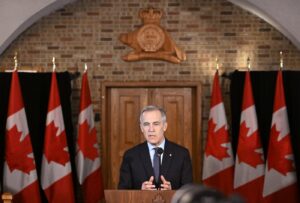
QUÉBEC — Staying true to Canada’s core values will be key to maintaining its sovereignty, Prime Minister Mark Carney said Thursday.
In a speech to kick off the cabinet retreat in Quebec City, Carney said Canada was created by people of different backgrounds coming together to build a nation on the principles of multiculturalism and openness.
With this foundation, he said, Canada can serve as a “beacon” to the rest of the world as authoritarianism spreads.
“In a time of rising populism and ethnic nationalism, Canada can show how diversity is a strength, not a weakness. In a time of democratic decline, we can show how rights can be protected and equal freedoms endure,” Carney said.
This speech comes two days after Carney delivered a high-stakes speech at the World Economic Forum in Davos, Switzerland — one which called on middle powers to band together in the face of “great power” economic coercion.
While Carney did not mention U.S. President Donald Trump by name, he was widely seen as taking a stand against the Trump administration’s use of tariffs and threats to conduct foreign policy.
That drew a rebuke from Trump, who said in his own address to the WEF on Wednesday that Carney should be “grateful” and “Canada lives because of the United States.”
Carney offered a reply to Trump in his cabinet speech.
“Canada and the United States have built a remarkable partnership in the economy, in security and in rich cultural exchange. But Canada doesn’t live because of the United States,” he said.
“Canada thrives because we are Canadian.”
Canada-U.S. relations will continue to be a top priority for the government as the Canada-U.S.-Mexico Agreement on trade, or CUSMA, comes up for review this year.
The retreat is being held at The Citadelle of Quebec, a military base and the secondary official residence of the governor general of Canada. The fortress was built in the 1800s by the British to protect the city from the threat of an American attack.
Carney and his cabinet are expected to hear from experts in government, finance, community services, advanced technology and global affairs during the two-day cabinet retreat.
“What they should be focused on is what’s the game plan for getting Canadians ready for what’s going to be a very rough year, with the prospect of more tariffs, more pain and (trade) negotiations that are clearly going to be taking place under the barrel of a tariff gun,” said Fen Osler Hampson, an international affairs professor at Carleton University.
Speakers attending the retreat on Thursday include Mayor of Quebec City Bruno Marchand, Food Banks Canada CEO Kirstin Beardsley and Scotiabank’s head of resilience economics Rebekah Young.
Ministers will also hear from Royal Bank of Canada chief economist Frances Donald and head of BlackRock Investment Institute Jean Boivin.
Jennifer Welsh, director of McGill University’s Max Bell School of Public Policy, said ministers will have to discuss how exactly they intend to diversify Canada’s trade relationships and build the economy.
“So what should be the priorities and what do international partnerships mean? How are we going to actually pursue them and realize them?” she said.
Osler Hampson said cabinet should also take time in Quebec to discuss making faster headway on major projects.
“We’re not going to be selling much to the world unless we build our infrastructure, build our ports, build our rail, build pipelines,” he said.
“That’s got to happen sooner rather than later if there are going to be jobs for those who are going to be thrown out of work.”
Carney cited several of his government’s priorities in his speech, such as boosting defence spending, developing an artificial intelligence strategy, advancing major projects and passing Criminal Code reforms.
Parliament is set to return Monday and Carney is expected to be challenged by the opposition to take action to fulfil the lofty messages in his speeches.
Carney’s Liberal government is two seats shy of a majority, after two Conservatives crossed the floor in the fall and the departure of Toronto MP Chrystia Freeland earlier this month.
This report by The Canadian Press was first published Jan. 22, 2026.
—With files from Kyle Duggan, Anja Karadeglija and Alessia Passafiume
Catherine Morrison, The Canadian Press