OTTAWA — The agreements Prime Minister Mark Carney brokered over the two days of his Beijing visit are the result of months of diplomatic work and cultural knowledge, international relations experts say.
Carleton University international affairs professor Fen Osler Hampson said Carney “would have not gotten on the plane” without knowing first he had “something big, some big bacon to bring back home.”
“The team supporting the ambassador would have definitely been working overtime on this one.”
On Friday, Carney announced China had agreed to lower agricultural tariffs in exchange for some access for Chinese electric vehicles to the Canadian market, and that Beijing had agreed to eventually loosen its visa requirements for Canadian visitors.
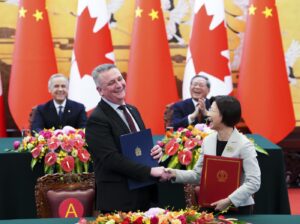
A day prior, he oversaw the signing of agreements touching on finance, pet food, lumber, oil and green technology.
Asia Pacific Foundation vice-president Vina Nadjibulla said the agreements are the product of “an iterative process” of discussions between bureaucrats and political leaders that required each side to build momentum ahead of the high-level visit.
That process likely kicked off around the time of Carney’s phone call with Premier Li Qiang in June, which was followed by two meetings with Li at the United Nations last September and then the October meeting in South Korea between Carney and President Xi Jinping.
“Between these leader-level conversations that create the political space — that signal what’s possible — then the working level officials, the whole machinery of government both in Canada and in China … is mobilized, to try to act on whatever commitment, whatever opening was created in those discussions among leaders,” Nadjibulla said.
She said the meeting between Xi and Carney in October must have led to 11 weeks of intense discussions between officials.
“The bureaucracies in both countries had to work full-speed — including through the Christmas holidays for us here in Canada — to try to get to the point of them getting on a plane and travelling to Beijing,” she said.
“And then when they arrived, they would have also had to work around the clock,” she said, noting the government’s statement Thursday that they were still talking about tariffs on the eve of the leaders’ meeting.
“Until the last minute, there is still discussions and negotiations and things get included and things can take taken out — and they’re not small things.”
Such meetings between national leaders are preceded by months of Zoom calls, planning meetings, consultations with federal departments and provincial leaders, analyses of China’s recent work with other partners and efforts to revive joint projects.
Nadjibulla gave the example of the Canada-China Economic and Financial Strategic Dialogue, a working group that was meant to hold regular meetings. It met only once — in November 2018 — before the diplomatic crisis over China’s detainment of two Canadians in retaliation for the Vancouver arrest of a Chinese tech executive put diplomatic relations on ice.
That body will finally resume its work, both nations announced Friday.
Hampson said diplomats and civil servants did “very intensive spade work beforehand, many months of hard work” that allowed Ottawa to send a large team of ministers to Beijing.
“You don’t go full Monty unless there’s going to be something to deliver,” he said.
Cultural factors can also help or hinder efforts to secure bilateral deals.
“In Asian cultures, personal relationships really, really matter,” Hampson said, adding Chinese culture also holds education in high regard.
Carney’s past experience with Chinese counterparts and his formal education likely won him some goodwill from the Chinese side, Hampson said.
“They take him seriously. You could see that in the body language,” he said.
“The meetings were in big rooms with big tables and lots of people sitting at them. And he had quite a lengthy meeting with Xi Jinping, so they would have talked about a lot of things.”
He contrasted this reception to the way China viewed former prime minister Justin Trudeau, whose father Pierre Elliott Trudeau had a history of co-operation with Beijing and the air of an intellectual.
“They kind of hoped he would be like his father, and it turned out he wasn’t. And so they were disappointed,” he said, arguing Carney’s resume opened doors in Beijing.
“That opened possibilities that simply weren’t there with Trudeau and wouldn’t necessarily have been there with a Conservative government either, had (Pierre) Poilievre won” last year’s election, he said.
Nadjibulla said Carney’s interactions with Xi are key to unlocking progress in the Chinese system — an efficient, hierarchical bureaucracy built to deliver on what Xi says is important.
“It gives permission, it gives instruction and gives direction to the system, to move and to find solutions and to work around certain issues,” she said.
She contrasted that approach with that of Canada, where policy is based on a democratic process shaped by public opinion, provincial governments, the private sector and civil society.
Nadjibulla said the deals signed this week could still hit hurdles if Ottawa moves forward with policies and statements that irritate Beijing. She cited the promised foreign agent registry and Canada’s stance on China’s South China Sea claims and its military manoeuvres around Taiwan.
This report by The Canadian Press was first published Jan. 16, 2026.
Dylan Robertson, The Canadian Press