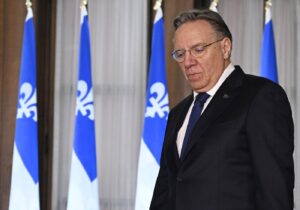
MONTREAL — One day after Quebec Premier François Legault said he would resign ahead of the October election, at least one high-profile minister has come out publicly to say she is considering a bid to replace him.
Speaking to reporters in the Montreal area, Economy Minister Christine Fréchette said, “I can see that my name was mentioned many times” as a possible successor to Legault.
“I am considering the party leadership. I will reflect on that in the coming days, so I will talk with colleagues, also with my family, other actors in society, and let you know the outcome of that reflection,” said Fréchette, who earlier in the day received the backing of another cabinet minister — Gilles Bélanger, who heads the cybersecurity portfolio.
“I think Christine is the best candidate,” Bélanger told The Canadian Press.
First elected in 2022 to the Montreal-area Sanguinet riding, Fréchette took over the important economy portfolio from departing minister Pierre Fitzgibbon in September 2024.
And while it took roughly 24 hours after Legault’s announcement for a potential candidate to come forward, there had been speculation for months that the premier would step aside, given his party’s dismal polling numbers.
Recognizing Quebecers’ desire for change, Legault announced Wednesday he would resign in the coming months after the Coalition Avenir Québec chooses a new leader in the party’s first leadership race. The 68-year-old Air Transat co-founder has served as the CAQ’s only leader since he co-founded the party in 2011, with back-to-back majority mandates in 2018 and 2022.
Meanwhile, Finance Minister Eric Girard said Thursday he was “interested” in the leadership but it was too early to say whether he would dive into a race without knowing the rules.
“I am interested in contributing to the party’s revitalization,” Girard said. “Quebec’s economic potential is exceptional, Quebec is a modern society, and it is our responsibility as a party to offer Quebecers a credible alternative.”
Université de Montréal political science lecturer Simon Dabin says one of the next leader’s biggest challenges will be to take a position on sovereignty, as the poll-leading Parti Québécois promises a third referendum by 2030 if elected. He said the question of Quebec’s place in Canada will likely be a defining one in the next campaign, and the next CAQ leader will have to “hold together legislature members who have diverse and varied opinions on a certain number of subjects.”
Legault began his political career with the Parti Québécois, but became disenchanted with the decades-old sovereigntist-federalist debate in the province, and created the CAQ to offer Quebecers a third way: a focus on Quebec nationalism and autonomy within the Canadian federation. Faithful to its name, the party is a coalition of federalists, sovereigntists and others whose affiliation is less well known.
Dabin, however, says Legault’s third way may be a difficult line to walk for his successor, especially as chances of a referendum increase. “The autonomist positioning of the CAQ, a position that made sense eight years ago, will be complicated to defend in a campaign” when sovereignty is a central issue, Dabin said.
And while no candidate has emerged yet for the party leadership, several names are circulating, including cabinet ministers Sonia LeBel, Simon Jolin-Barrette and Bernard Drainville.
Drainville, who was a PQ legislature member for nine years before leaving politics and returning as a member of the CAQ, told radio station 98.5 FM on Thursday that he isn’t ready to talk about a possible leadership bid.
“I’m not there yet,” the province’s environment minister repeatedly told host Patrick Lagacé, adding that he wanted to keep the focus on Legault.
He said he believed his party would remain relevant “as long as Quebecers are nationalist,” and that the CAQ, and he personally, have ruled out ever calling a referendum, though he didn’t answer when asked how he’d vote if one were to take place.
The party is facing a tight timeline to organize its first ever leadership race ahead of the election scheduled for Oct. 5. It will also have to contest a byelection in the Chicoutimi riding, which was left vacant by the September resignation of former CAQ municipal affairs minister Andrée Laforest.
Université de Montréal political science professor Frédérick Bastien says a party’s ability to move on from its first leader is a test of whether it’s there to stay. When asked whether the party would remain a political force without Legault, Bastien said it was still up in the air.
“It’s difficult to predict and it will depend on the person who will succeed him,” he said.
This report by The Canadian Press was first published Jan. 15, 2026.
Stéphane Blais and Morgan Lowrie, The Canadian Press