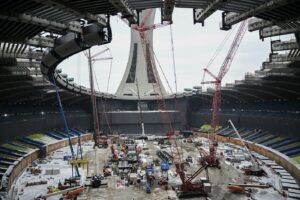
MONTREAL — Montreal’s Olympic Stadium started 2026 the same way it began the 1976 Games: under construction and without a roof.
In 2024, Quebec’s tourism minister announced the province would spend $870 million to replace the stadium’s roof, which was torn in more than 20,000 places and threatened to force the venue’s closure.
The Quebec government’s list of ongoing infrastructure projects also includes several stadium-related investments that aren’t part of the $870-million price tag, including $20 million for replacing sound equipment and $28.6 million for the electric system.
It’s only the latest round of spending for the Big O — sometimes dubbed the “Big Owe” for its runaway construction costs and contribution to an Olympic debt that took 30 years to pay off. But unlike in 1976, those in charge of the project say the work is on time and on budget, and that this roof will last.
Daniele Malomo, an assistant professor of civil engineering at McGill University, says the Olympic Stadium was designed by French architect Roger Taillibert as a “concept” rather than a practical space. Quebecers, he said, have been paying the price ever since.
“This thing was designed against the law of gravity,” he said in a phone interview.
Taillibert’s vision included a massive concrete dome with a retractable roof, held up by cables suspended from the world’s largest inclined tower, at 165 metres high. Malomo says the roof design was an “engineering nightmare” in Quebec’s climate, but also blames the stadium’s costs on a failure to properly maintain it early on.
“This was built in the time where people were allowed to dream,” he said. “And now we’re waking up with something that is a statue, it’s not a building,” he said. “It’s too complex to stand without pouring money into it.”
Although the main Olympic Stadium was built just in time to host the Games, the roof wasn’t completed until 1987. It was replaced in 1998 with a non-retractable roof made of Teflon-coated fibreglass that proved equally unreliable, rendering the stadium unusable when more than three centimetres of snow fell.
The government has promised the new roof will allow the stadium to stay open year-round and almost triple gross revenue.The project is expected to be complete in 2028, with the new roof expected to last 50 years.
On Thursday, the stadium floor was buzzing with activity as dozens of vehicles, cranes and workers moved in the shadow of the inclined tower under a cloudy January sky.
Nadir Guenfoud, vice-president for Olympic Stadium roof modernization and replacement, said the crews were working at installing the technical ring that runs around the stadium’s top edge. The ring, which is being raised in 38 segments, will house equipment such as ventilation and lighting, and will support a new sound system.
The next step will be to build the new roof on towers inside the stadium. The roof will then be hoisted up and attached to massive cables suspended from the tower. The roof will not be retractable but will have a translucent perimeter to allow light to shine through.
In an interview at the stadium, Guenfoud said the project is on schedule and on budget. An engineer by training, he expressed confidence that this roof, unlike its predecessors, would perform as promised.
“All of this has really been thought through in a very careful way,” he said.
That’s not to say there aren’t challenges, he added. Crews are working with parts that can be 50 metres long, on a building where nothing is standard. “It’s a very particular architecture, everything is curved, and there aren’t two structural pieces that are the same,” he said.
JC Bradbury, an economics professor at Kennesaw State University in Atlanta, Ga., says Quebecers will likely never see a return for their money. He said sports stadiums, no matter where they are or how they’re designed, simply don’t generate the returns to justify public spending, despite politicians’ promises.
“There’s sort of this general idea that you build a stadium and that it’s going to be an economic development catalyst and there are going to be all these businesses that are going to crop up to serve the spillover commerce that happens,” he said. “And what we see is, that rarely happens.”
He said the Olympic Stadium is likely no exception, adding that it’s unlikely to be chosen to host major international events without further renovations to align it to modern tastes, which include more luxury seating that’s close to the action on the field.
Guenfoud acknowledged the building will likely need further modernization.
While the new roof and technical ring will help with elements such as acoustics, he said other parts of the stadium are “worn” and need replacement. “We are still planning for other interventions, so that’s what we are studying with the government to see which ones we can prioritize,” he said. The Quebec Tourism Department referred questions on cost back to stadium management.
At 56,000 seats, the Olympic Stadium is the biggest event space in the province. Fans of the building defend its value, and note that the Quebec government has cited a $2-billion price tag to demolish it.
Dinu Bumbaru, the policy director for Heritage Montreal, says the stadium is a defining feature of the city’s skyline and a landmark associated with countless memories, even if some of them concern financial mismanagement rather than sporting triumph.
But he notes that many cities have opted to demolish significant buildings in the past, and later regretted doing so. He said the favoured approach today is generally to make the best use of existing buildings, and he believes that’s also the best approach for the stadium.
“Sometimes it means that we have to invest to correct the mistakes or the neglect of the past,” he said.
Malomo says it’s clear the stadium will need further investments and maintenance, like any building. However, he believes costs will stabilize in coming years.
Like Bumbaru, he’s not a fan of tearing the building down, noting the financial, environmental and cultural costs. He calls himself a “big fan” of the stadium, despite its issues.
“I think demolishing it would be unthinkable,” Malomo said.
This report by The Canadian Press was first published Jan. 11, 2026.
Morgan Lowrie, The Canadian Press