TORONTO — The daring ouster of the president of Venezuela by the U.S. military sent shockwaves through the Western Hemisphere as President Donald Trump heralded the operation in the oil-rich Latin American nation a success.
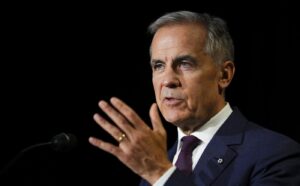
Prime Minister Mark Carney reacted on Saturday afternoon by noting that one of the first actions taken by his new government in March was to impose additional sanctions on Nicolás Maduro’s “brutally oppressive and criminal regime.”
In a statement posted to social media, Carney noted that Canada has not recognized “the illegitimate regime of Maduro since it stole the 2018 election.”
“The Canadian government therefore welcomes the opportunity for freedom, democracy, peace, and prosperity for the Venezuelan people,” Carney wrote.
But he also wrote that Canada has “long supported a peaceful, negotiated, and Venezuelan-led transition process that respects the democratic will of the Venezuelan people,” adding that Canada calls on all parties to respect international law.
“We stand by the Venezuelan people’s sovereign right to decide and build their own future in a peaceful and democratic society,” Carney’s statement said.
U.S. military forces extracted Maduro and his wife, Cilia Flores, from their home on a military base in Caracas in a whirlwind military operation which saw multiple explosions ring out as low-flying aircraft swept through the nation’s capital.
The duo were brought to New York where U.S. Attorney General Pam Bondi said they will face several drug-related charges, including “narcoterrorism” conspiracy charges. Maduro and other Venezuelan officials were indicted on similar charges in 2020.
Conservative Leader Pierre Poilievre congratulated Trump for capturing Maduro, referring to Venezuelan leader as a “terrorist and socialist dictator who should live out his days in prison.”
Toronto-based Venezuelan activist Rebecca Sarfatti said she was caught by surprise early Saturday when several group chats with loved ones in Caracas started buzzing about the operation.
The 54-year-old, who has been in Canada since 2001 and is the co-founder of the Canada Venezuela Democracy Forum, said her initial concern for people in Caracas at the outbreak of the attacks has faded into hope for the future of her country.
“I never thought I would live to see something like this or experience something like this,” she said. “I’m definitely happy because (Maduro’s) going to be taken through the courts. The outcome for Venezuelans is the right thing.”
“My hope is that we are able to recover a peaceful country that has been hostage for too many years,” she said.
The Green Party of Canada, however, slammed the development as a violation of international law and called the military action a “kidnapping.”
The Canadian government issued a travel warning Saturday afternoon urging all Canadians to avoid Venezuela due to a significant level of violent crime, unstable political and economic environment, risk of arbitrary detention and decline in basic living conditions.
The advisory said Canada’s ability to provide consular services to Canadians in Venezuela is “severely limited and done remotely.” It urged those who were in the country to shelter in place and make sure to keep a supply of essential items.
The Canadian Press has reached out to Global Affairs Canada to confirm whether they have seen requests for aid.
Speaking to reporters hours after Maduro’s capture, Trump revealed his plans to exploit the leadership void to “fix” the country’s oil infrastructure and sell “large amounts” of oil to other countries.
“Where (Trump’s) gone now is something that certainly everybody in the hemisphere has to take note of and is taking note of,” said Kenneth Frankel, president of the Canadian Council for the Americas. “Because it’s unclear what the U.S. thinks its limitations are in terms of how it imposes its will to protect its expanded view of what its security concerns are right now.”
Frankel, who spoke from Medellín in neighbouring Columbia, said once you look past the questionable pretenses for the U.S. action — in this case drugs and human rights — “I think Trump was very, very clear in his press conference today … it’s about the resources.”
It’s unclear what could emerge in the vacuum caused by Maduro’s ouster in Venezuela and throughout the region. For Maduro critics, Saturday’s operation may seem like a success, but Frankel said “nobody knows what happens on day two, day three, and, you know, month two and month three and beyond.”
Frankel said if the situation is about oil and not necessarily about restoring order, “what does that mean, for example, for the Colombian-Venezuelan border, where there are a number of bad actors, all of whom are armed, who sometimes work in conjunction with the government, some of which maybe the government doesn’t have a great control of?”
“With Maduro out of the picture and the U.S. unhappiness with (Colombian President Gustavo Petro), who will be the interlocutor for Columbia to speak with in Venezuela on border issues?”
— with files from Kelly Geraldine Malone in Washington and The Associated Press
This report by The Canadian Press was first published Jan. 3, 2026.
Cassidy McMackon, The Canadian Press