OTTAWA — As Prime Minister Mark Carney puts trade and security at the centre of Canada’s foreign policy, observers say Ottawa is also shifting how it asserts its values on the world stage.
The Liberals insist they are still standing up for human rights globally while seeking investment from China, India and Gulf countries. But a change in priorities is prompting some criticism — and changing how Canada trains its diplomats.
“They won’t say out loud (that) we’re going to be less interested in values, but clearly that seems to be the case,” said University of Ottawa professor Stephen Brown.
Last month, Carney told reporters that while Canada no longer has an explicitly feminist foreign policy, his government is still upholding values that include defending LGBTQ+ rights abroad and combating violence against women.
“Yes, we have that aspect to our foreign policy, but I wouldn’t describe our foreign policy as feminist foreign policy,” Carney said during the G20 summit in Johannesburg.
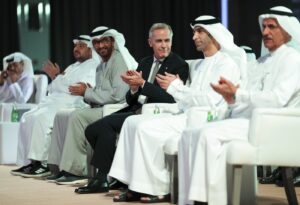
His comments came after mounting criticism from human rights advocates on other themes, such as Carney courting investment from the United Arab Emirates amid widespread allegations the country is fuelling ethnic violence in Sudan.
Former foreign affairs minister Lloyd Axworthy has accused Carney of taking a “bootlicking” approach to U.S. President Donald Trump, by muting a focus on Canadian values in order to try salvaging trade access.
He has criticized the government for being part of “a breakdown of collective courage” globally. For him, that includes not calling out the U.S. for sanctioning members of the International Court of Justice — inducing a Canadian.
Axworthy also laments that Ottawa is not mounting a robust campaign to stop countries from exiting the Ottawa Treaty that Axworthy had brokered to prevent the use of landmines.
In November’s budget, the government signalled it would scale down funding for global health initiatives, “where Canada’s contribution has grown disproportionately relative to other similar economies.”
Brown, whose research focuses on foreign aid, said that effectively means “we were being leaders, and we don’t want to be leaders anymore.”
He said Canada is increasingly seen by its peers as placating the Trump administration instead of asserting its own vision of human rights and international law.
“Reputation is a currency, and it can count for a lot in international negotiations,” Brown said.
“If people just see Canada as … too afraid to disagree with the Trump-led United States — if Canada won’t stand up for Canadians abroad, then Canada can be seen as a pushover. And that weakens us on the international level.”
Foreign Affairs Minister Anita Anand has insisted that Canada is still advancing human rights, which she outlined as a third pillar of Canada’s foreign policy alongside economic security and defence, in her inaugural United Nations speech as Canada’s top diplomat.
She told the House foreign affairs committee on Nov. 27 that shifting geopolitics required Canada to change how it talks about values.
“We are going to make sure that our commitments to gender equality, human rights, women and girls will continue in a way that recognizes the new geopolitical and fiscal context — both of which demand a different frame,” she testified.
That new frame seems to have changes how Global Affairs Canada trains its diplomats.
Stephen Nagy, a Canadian who works as a politics professor at the International Christian University in Tokyo, has been commissioned by GAC at various points to train diplomats.
In his recent Indo-Pacific regional security course, Nagy said the department didn’t ask him to touch on gender and identity issues, despite this being part of the scope in previous years.
“That tells me a lot about the direction,” he said. “If these were priorities, that course would have had at least two hours on it, but it went through multiple layers of the bureaucracy, and they didn’t ask for any inclusion of those issues.”
Nagy, who is a senior fellow with the Asia-Pacific Foundation, said the Trudeau government had put environmental, labour and gender issues “at the forefront” of its engagement across Asian countries who wanted to instead emphasize trade, security and supply chains.
“Whether it was Beijing or Tokyo, Seoul, Singapore or Hanoi, the values-based approach to Canadian diplomacy in the region was by and large seen as schizophrenic at best, and completely misguided, at worst,” he said.
He said it is sensitive in many Asian cultures to raise LGBTQ+ rights, with the exception of Taiwan.
At a November 2017 summit in Vietnam, former prime minister Justin Trudeau infamously skipped a meeting aimed at launching a trade deal that had been termed the Trans-Pacific Partnership, and later agreed to join the pact after the words “Comprehensive and Progressive” were added.
“People still bring it up, which is shocking to me,” he said.
Brown said Canada’s feminist foreign policy was a major part of how the Trudeau government was seen on global issues, along with a focus on human rights, but he argues Ottawa lacked coherence in advancing those issues.
He said trade agreements touched on these issues “in a non-enforceable way,” with language that might nudge countries to do more but without actual repercussions for not doing so.
On aid, Ottawa had specific targets for women benefiting from development spending and peacekeeping training funded by Canada. In diplomacy, there were informal efforts to boost the number of women in senior postings.
But Brown said the policy didn’t aim to structurally change how aid, the military or diplomacy shape women’s lives.
“They didn’t transform the core in any way,” he said. “To me, they all seem pretty ad hoc, and often at the margins of what was really going on in those various departments and programs.”
Under Carney, Ottawa is still trying to advance gender equality, but with an economic focus.
Ahead of the G20 summit in November, Canada’s envoy listed priorities that included “advancing gender equality as a key contributor to inclusive and sustainable economic growth.”
That phrasing was a shift from Ottawa’s past emphasis on thornier issues at the G20, such as sexual health and reproductive rights.
Nagy said the economics framing is a smart way to have an impact “by just slightly tweaking the expressions” of a human-rights policy — instead of being seen as advancing issues that might be controversial in certain countries.
“We need new formulas of trying to achieve those human-rights objectives, which are really, really critical to human development,” he said.
Nagy said the Trudeau government was still seen as a valuable partner in Asia for its work in areas like detecting vessels that are trying to evade radar detection for fishing or evading sanctions.
He said having Carney in charge has boosted hopes across Asia that Canada will provide more of this practical assistance.
“I hear great relief in capitals in the region. They’re happy that critical minerals and energy resources are going to be exported to the Indo-Pacific region and that pipelines are being built, and that Canada can be that kind of reliable energy and critical-mineral superpower that can help keep the region going,” he said.
“They’re relieved that they don’t have to talk about gender politics and identity politics anymore.”
This report by The Canadian Press was first published Dec. 29, 2025.
Dylan Robertson, The Canadian Press