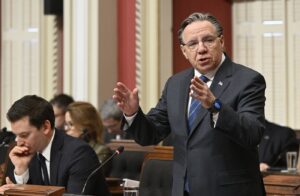
Five things to know about Quebec Premier François Legault’s tough year in 2025
By Canadian Press on December 22, 2025.
QUÉBEC — Quebec Premier François Legault is finishing 2025 with his party running in third place in the polls, behind the Parti Québécois and the Liberals. The polling caps off a difficult year that saw his party lose six legislature members, including five who are now sitting as Independents.
With just nine months until the next provincial election, here are five things to know about the premier’s tough year.
The deficit “Super King”
Legault was given that unflattering nickname by the Liberals after his Coalition Avenir Québec party announced a record $13.6-billion deficit in March. Days later, credit agency Standard & Poor’s lowered the province’s credit rating for the first time in 30 years. Opposition parties have accused Legault of mishandling public finances, citing a $46-million engineering contract relating to a controversial project to build a third span across the St. Lawrence River connecting Quebec City and its south shore, and millions of dollars in losses due to the failure of the Northvolt electric battery plant project.
An auto insurance board “fiasco”
The Legault government suffered another blow in February when the province’s auditor general revealed cost overruns of at least half a billion dollars in the creation of the online platform known as SAAQclic. The botched 2023 rollout of the platform led to major delays and long lineups at insurance board branches, where Quebecers take road tests, register vehicles and access other services. The scandal led to months of public hearings earlier this year, during which Legault testified that he was kept in the dark about the cost overruns and laid most of the blame for the scandal on the leaders of the state-run corporation. Éric Caire was forced to step down as cybersecurity minister following the explosive auditor report, while former transport minister François Bonnardel was shuffled out of cabinet and his successor to the post, Geneviève Guilbault, was moved to municipal affairs.
Doctors uprising
The adoption in October of a controversial law on physician remuneration led to widespread protests by doctors, some of whom publicly threatened to leave the province. The legislation, which tied part of physicians’ remuneration to performance targets and threatened steep fines for those who use pressure tactics to boycott the changes, also had opponents within Legault’s own party. The premier, who had promised not to back down on the legislation, got personally involved in the negotiations with family doctors. The result was a watered-down law that removed performance-related penalties in favour of a system of incentives. The dispute cost Legault’s party three legislature members, including two cabinet ministers. Junior health minister Lionel Carmant and MNA Isabelle Poulet quit the party in protest of the initial law, while Christian Dubé resigned as health minister in the wake of the deal that weakened the legislation.
A wave of departures
Carmant, Poulet and Dubé weren’t the only legislature members to leave Legault’s party to sit as Independents. In September, the premier expelled Pierre Dufour, the MNA for Abitibi-Est, from the CAQ caucus. In an interview with La Presse that month, Dufour had suggested he would resign and run for mayor of Val-d’Or if the premier did not appoint an elected official from the Abitibi-Témiscamingue region as a minister. That same month, Maïté Blanchette Vézina, who had recently been shuffled from cabinet, quit the party to sit as an Independent, suggesting she’d lost faith in Legault and that his policies have neglected Quebec’s regions. In total, Legault’s party has lost 10 of its legislature members since the 2022 election. The Parti Québécois, which currently leads in the polls, has won the last three byelections.
A potential successor?
While Legault has insisted that he plans to run again in 2026, that hasn’t stopped the rumour mill from circulating names of potential successors. According to the polling firm SOM, leading candidates include Justice Minister Simon Jolin-Barrette and Education Minister Sonia LeBel, followed by Dubé and Guilbault. Economy Minister Christine Fréchette and Environment Minister Bernard Drainville are also seen as potential successors. But for the moment, nobody has emerged as a clear front-runner, and there is no public revolt against Legault, the party’s leader and founder.
This report by The Canadian Press was first published Dec. 22, 2025.
Caroline Plante, The Canadian Press
17
-16