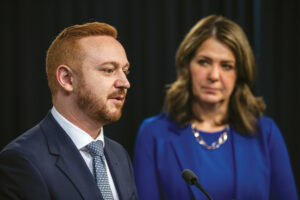
Minister of Justice Mickey Amery speaks in Edmonton on April 29, 2025 as Premier Danielle Smith looks on.--CP FILE PHOTO
zmason@medicinehatnews.com
A new bill tabled Monday introduces another round of changes to legislation governing recalls and citizen initiative petitions.
Bill 23 would update several pieces of legislation, including the Citizen Initiative Act and the Recall Act.
“We are committed to protecting the integrity of our elections and our democracy, and we believe that these amendments will do just that,” said Justice Minister Mickey Amery at a press briefing Monday.
Changes outlined create a blackout period for starting or continuing citizen initiative petitions one year before and after a general election.
Amery says the purpose of the amendments is to allow Albertans to pay equal attention to general elections and to citizen initiated referendums.
“The purpose of these amendments is not to commingle them or to create a scenario where they’re operating at the same time, because I think that Albertans deserve to have an unfettered line of view on both of these very important issues,” he said.
It also repeals the deadline by which the government is required to hold a referendum. Under the current legislation, the government is required to hold a referendum on a successful petition question on or before the date of the next general election.
“I certainly wouldn’t foresee a scenario where a question would be put aside or held over for 10 years,” said Amery. “I think everything that we’ve done thus far has created an environment to make it easier, rather than harder, for Albertans to ask important questions.”
The legislation enables parties involved in recall or citizen initiative petitions – including proponents, the minister of justice or the affected MLAs – to appoint scrutineers to oversee signature verification.
Amery says the amendments will not be retroactive, meaning citizen initiatives already gathering signatures will not be impacted by the changes.
The UCP government introduced legislation in July 2025 to lower the threshold for advancing citizen initiatives. Bill 23 is the latest in a series of updates to the legislation since then.
The government increased fees associated with launching a petition drive from $500 to $25,000 in December. They also passed Bill 14, which transferred authority over whether a petition should proceed from the chief electoral officer to the minister of justice.
Monday’s introduced bill also proposes changes to two other acts.
The amendments to the Public Sector Compensation Transparency Act would lower the threshold for public sector compensation disclosure to $130,000.
Changes to the Election Finances and Contributions Disclosure Act include new measures around the treatment of ‘deepfakes.’ The proposed changes would prohibit individuals from creating deepfakes that are likely to mislead voters about the conduct or statements of a candidate, minister or elections employee.
Violation of the new policy could result in fines up to $10,000 for individuals and $100,000 for organizations.
Amery says broader legislation regulating deepfakes is forthcoming.
“We know that deep fakes are getting better and better. We know that the technology is improving with each and every day. We want to keep our elections fair and honest, and a lot of this is driven by the desire to proactively meet the threats as they come,” he said.