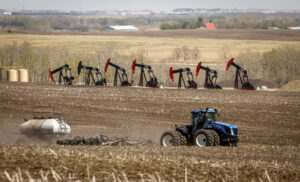
A farmer drives a seeding rig past oil and gas pumpjacks as he plants a wheat crop near Cremona, Alta., on May 6, 2025.--CP Photo Jeff McIntosh
zmason@medicinehatnews.com
A new report accuses the Alberta Energy Regulator of not doing enough to address the problem of unpaid oil and gas property taxes.
The Property Tax Accountability Strategy report released Monday was the product of a working group comprised of Alberta’s government, the Rural Municipalities of Alberta and rural municipal administrators. Representatives from the AER also participated in the working group, as well as oil and gas industry representatives who participated as observers.
Data collected separately by the provincial government and by the RMA both peg the total of unpaid property taxes around $250 million, and growing.
“Unpaid taxes put an unfair burden on Alberta taxpayers, who end up footing the bill or seeing their services reduced. Our government is focused on working with our municipal and industry partners to improve the way we address unpaid taxes to benefit them and taxpayers alike,” said Minister of Municipal Affairs Dan Williams in a release Monday.
The Property Tax Accountability Strategy working group was announced by the province last March. Monday’s report contains 17 recommendations, including new powers for the AER and new conditions on obtaining AER licences.
One of the report’s findings was that the Alberta Energy Regulator is not sufficiently transparent or consistent in its current use of unpaid tax information to inform enforcement action and risk assessments.
Under the current regulatory framework, the AER does not have the ability to undertake enforcement on the basis of unpaid taxes alone. However, it can use tax payment performance to guide decisions about enforcement and risk assessment.
In recent years, the authority of the AER has been expanded in an attempt to address the growing debt to municipalities.
The AER was granted new powers that enable it to consider unpaid property taxes in risk assessments of oil and gas companies and a limited authority to prevent the acquisition of new well licenses or transfers when municipal tax arrears are present.
However, Monday’s report found that it is unclear when and how the AER uses that authority to limit the operations of unreliable oil and gas companies.
The report says that over the course of the working group process, “the AER was unable to provide clarity as to how often they utilized unpaid tax data for these purposes, [or] how it was weighted in relation to other factors.”
The report also noted that the AER indicated unpaid tax data was not uniformly integrated into decision-making regarding enforcement and risk. Rather, unpaid tax data was considered only on a case-by-case basis.
The report argues that this lack of a clear standard weakens the deterrent by failing to demonstrate clear consequences for companies that fail to pay property tax.
In addition, under the current regulatory framework, property tax payment is not treated as an explicit condition to holding or maintaining an AER licence.
Among the 17 recommendations in the report, the working group suggests establishing it as such.
The report also recommends empowering the AER to initiate compliance action solely based on a licensee’s tax arrears. Currently, tax arrears are not sufficient cause for the AER to intervene with some of the measures in its toolkit, such as licence conditions, restrictions, or suspensions.
RMA president Kara Westerlund says this report is proof that collaboration between government and rural municipalities can drive meaningful solutions.
“When implemented, the recommendations will provide the AER clear authority to take enforcement action when companies have unpaid property taxes, will improve unpaid tax data and use, and will lead to long-term collaboration between municipalities, government and the AER,” said Westerlund.
The report is oriented toward making policy to prevent further losses in the future. Taxes already left unpaid, it argues, are unlikely to be recovered.
The data in the report shows the problem of unpaid municipal taxes from oil and gas companies is widespread and growing.
RMA’s 2025 survey, which looked at arrears as of Dec. 31, 2024, identified a cumulative total of $253.9 million in arrears, including outstanding taxes and historical write-offs.
The Ministry of Municipal Affairs, also looking at the period ending Dec. 31 2024, identified $158 million in outstanding arrears and $90 million in write-offs, which they conservatively estimate are valued at $110 million today, for a total of $248 million.
Both datasets include more than 200 companies in arrears – RMA identified 201 companies, while Municipal Affairs found 300.
The report also found the proportion of arrears owed by non-operational companies is increasing.
RMA’s figures show arrears owed by non-operational companies increased form 52 per cent in 2022 to 60 per cent in 2025. The province’s findings showed a similar increase, from 42 per cent non-operational in 2022 to 60 per cent in 2025.
According to the RMA’s data, 97 companies owed more than $20,000. This number is even higher in provincial numbers, with 147 companies owing more than $20,000.
The oil and gas sector contributes approximately $1.66 billion annually in municipal property taxes, plus approximately $260 million in education property taxes.
Municipal governments in Alberta get unfairly blamed for having to increase municipal property taxes, when the UCP are to blame, by supporting corporate welfare.








Municipal governments in Alberta get unfairly blamed for having to increase municipal property taxes, when the UCP are to blame, by supporting corporate welfare.