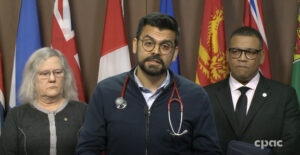
Dr. Danyaal Raza (centre), representing Canadian Doctors for Medicare at a press conference Thursday, is joined by president of the Canadian Medical Association Margot Burnell and chair of the Canadian Health Coalition Jason MacLean. Canadian Doctors for Medicare is one of 23 health and labour groups asking the federal government to stop Alberta's Bill 11.--CPAC SCREENSHOT
zmason@medicinehatnews.com
ZOE MASON
zmason@medicinehatnews.com
Health and labour groups from across the country signed an open letter this week asking the federal government to intervene in Alberta’s plan to adopt a dual-practice health-care system.
On Thursday, several national health groups condemned Alberta’s Bill 11, which will enable doctors in the province to bill both the public system and private payers for the same services, at the same time.
“We’re standing here as doctors, as health care workers, and we can see every day what happens when some of our patients cannot access the care they need. We see the fear, the suffering, and we know the harm that will come from a system that prioritizes wealth over need. This is not the Canada that we train to serve,” said Dr. Danyaal Raza, a family physician and a board director of Canadian Doctors for Medicare.
“We desperately need some federal leadership that will fight for something better.”
A coalition of 23 health and labour organizations issued a joint call to action to Prime Minister Mark Carney and Minister of Health Marjorie Michel.
The dual-practice system outlined in Bill 11 would allow physicians to bill the public system while simultaneously charging other patients privately.
Premier Danielle Smith was asked at an unrelated press conference Thursday to respond to the group’s concern that the changes could lead to longer wait times and physician shortages in the public system.
“Well, they’re wrong,” she said, shifting the focus East. “I think what we’ve observed in Quebec is because Quebec has made their doctors make a choice between public or private, they’ve seen an increasing number of doctors go into the private system, and not be available … to do public surgeries, and we don’t want that to happen here. Our priority is the public system.”
The premier said the province will ensure doctors provide the same amount of care in the public system they do now.
“We’re anticipating this will reduce waiting lists and provide better care,” Smith said. “So we just have a fundamental difference of opinion.”
Raza says this kind of safeguard doesn’t work.
In the U.K. and Ireland, he says limits on where doctors spent their time in a dual-practice system were routinely violated until the government dropped the requirement.
Dr. Braden Manns, a doctor and professor at the University of Calgary, said here in Canada, early attempts to introduce parallel private systems have come at the cost of public health-care capacity.
Manns said dual practice was allowed for cataract surgeries in Manitoba for a period of time in the 1990s.
During that period, he says the average wait time was 10 weeks for a public surgeon and four weeks for a private one. However, to have a publicly-billed surgery performed by a surgeon also working in the private system, the wait time jumped to 23 weeks.
Manns says allowing the same doctors to practice in both systems will naturally increase wait times for the public queue.
“In my clinic, I could see publicly-funded patients who have waited nine months to see me, but I might save two or three spots to squeeze in people who have waited one or two weeks if they’re willing to pay four times as much,” he said.
“A private, for-pay system doesn’t work if you don’t allow your public wait times to rise. I’m not going to be willing to pay four times as much unless there’s a significant discrepancy in how quickly I move forward in the health-care system.”
He says other countries with more private-payer surgeries, like Australia and the United Kingdom, have longer public wait times.
Here in Alberta, he says wait times for critical surgeries in the public system like cancer and heart surgeries have seen wait times go up since the province began diverting more cataract surgeries and knee replacements to chartered surgical facilities in 2021.
“They’ve done a very poor job of workforce planning. So we’ve got half the physicians as other countries that offer private for-pay surgeries. In Alberta, that means fewer staff, fewer surgeons, fewer anesthetists, and they’ll be diverted away from the public system.”
Prior to 2021, around two thirds of cancer surgeries were completed within the clinically recommended wait time. Now, only around half meet that benchmark.
Doctors at Thursday’s conference described Bill 11 as a clear violation of the Canada Health Act, citing the act’s criteria for universality and accessibility.
Alberta’s health ministries have previously told the News that dual practice does not violate the Canada Health Act.
“The Act is silent on private practice operating outside the public system, and opt-out and dual-practice models in Alberta and other provinces have never been found to breach it,” said the Ministry of Private and Preventative Health Services last month.
Smith says the legislation enabling dual practice will be coming forward during this session of the legislature.
Other signatories on Tuesday’s open letter include Friends of Medicare, the United Nurses of Alberta, AUPE and the Alberta Federation of Labour, as well as numerous national groups and groups from other provinces.
The federal Ministry of Health did not respond to a request for comment from the News.