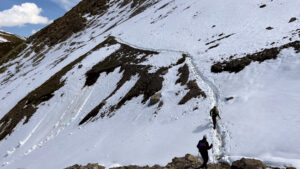
Snow from a late snowfall blankets the top of a mountain in Kananaskis in June 2025. This year, the Canadian Rockies saw record-breaking snowfalls early in the winter season. Lake Louise Ski Resort reported 504 cm by Dec. 27, breaking a 75-year-old record for early season snowfall.--News Photo Zoe Mason
newsdesk@medicinehatnews.com
Based on the current snowpack across the province, provincial environmental ministries are projecting a better year for water supply.
Alberta has endured dry conditions for several years, but early findings from the monthly snowpack surveys have shown the most favourable conditions for early-season water supply since early 2022.
February’s snow survey results show snowpack conditions ranging from normal to significantly above normal.
Basin-wide mountain snowpack averages are between 44 mm and 172 mm more snow-water equivalent than the same time last year.
“This is great news for our farmers, businesses, communities and all Albertans who use and rely on water each and every day,” said Minister of Environment and Protected Areas Grant Hunter. “We will continue closely monitoring our supply over the coming months and keep working to help build a more drought-resilient province.”
Based on the February outlook, river volumes are expected to be greater than those seen in 2025, in some cases by significant margins.
The Milk River basin in southern Alberta is expected to see normal river volumes, while forecasts range from normal to above normal for the Bow and Oldman River basins.
The North Saskatchewan and Red Deer River basins are projected to see above normal river volumes.
Water storage levels in major reservoirs across southern Alberta are also trending positively, with total storage normal in the South Saskatchewan River basin and the Oldman River basin, and above normal in the Row River basin.
“There have been plenty of challenges thrown at our farmers and ranchers over the past few years and, while growing conditions were better in 2025 for most of the province, localized weather events and other stressors put pressure on many producers. I’m optimistic that early moisture indicators paint a positive picture for the 2026 growing season.” said Minister of Agriculture and Irrigation R.J. Sigurdson.
Drought stages in Alberta range from Stage 0 (no drought conditions) to Stage 5 (severe drought conditions). The Milk River, Bow River and South Saskatchewan River basins are all rated as Stage 2 as of Jan. 31.
The province conducts mountain snowpack surveys monthly from Feb. 1 to June 1.
Alberta usually receives most of its moisture during March and April snowfalls and June rains.