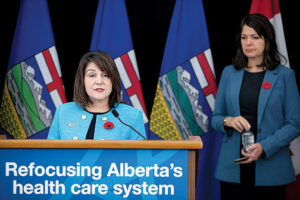
Premier Danielle Smith and Minister of Primary and Preventative Health Services Adriana LaGrange say Alberta's dual-practice model is following the example set by other Canadian provinces. But no province allows the "flexible participation" outlined in the legislation, and experts say it has the effect of creating a two-tiered system.--CP FILE PHOTO
zmason@medicinehatnews.com
Experts say Bill 11, the Health Statutes Amendments Act, represents the foundations for the first two-tier health-care system in Canada.
Although the province says it is drawing on other jurisdictions, including other Canadian provinces, for inspiration in the system’s design, experts say the dual-practice model proposed is unprecedented in Canada.
In public statements after the November tabling of the bill, Alberta’s health ministers compared the proposed system to the combination of public and private services already offered in New Brunswick and Quebec.
“In New Brunswick, a physician can toggle between on a case-by-case basis, to provide public or private service. So again, we do have examples of this within Canada,” said Minister of Primary and Preventative Health Services Adriana LaGrange.
But the health minister of New Brunswick says that is not the case.
In a statement to the News, New Brunswick Minister of Health John Dornan said New Brunswick does not use a dual-practice model for physicians.
“Physicians in the province either work in New Brunswick’s public health system, under the Medical Services Payment Act, which means they bill Medicare for insured services, or they work privately,” he said.
There are also limits on the types of services eligible for private practice in New Brunswick. Physicians are not allowed to opt out of Medicare for emergency care, or for ongoing care that has already been provided under Medicare. Hospital services can also only be administered privately if the patient agrees before admission.
“Additionally, opting out should not result in the patient being denied reasonable access to necessary insured services,” said Dornan.
No such guardrails have been applied to Alberta’s private practice model, and any limitations to come will be dictated by regulation and not determined in the legislature.
Experts say if the law were brought into force as currently written, physicians and surgeons could charge privately for medically necessary services covered under public insurance on a case-by-case basis, with no constraints.
Premier Danielle Smith told the News in a December interview that she imagined surgeons and doctors will have to guarantee they will provide the same amount of care in the public system that they already provide.
“Then they may be able to augment for those elective surgeries and get greater capacity and do more,” she said.
But no such guarantees are written into the legislation.
Quebec likewise allows physicians to choose either in or out. After introducing the choice to opt out of Medicare, Quebec lost so many physicians to the private sector that it passed new legislation last spring requiring physicians trained in Quebec to spend their first five years in practice in the public sector.
Between 2020 and the introduction of that legislation, the number of physicians leaving the public system increased by 80 per cent.
A report released jointly by the Parkland Institute and the Canadian Centre for Policy Alternatives on Tuesday says the changes introduced in Bill 11 effectively lay the blueprints for the first two-tier system in Canada, in violation of the Canada Health Act.
“When we say two-tier, we mean one that explicitly and very deliberately provides faster access to those with the ability to pay privately and longer public wait times for everyone else,” said co-author Rebecca Graff-McRae, research manager for Parkland Institute.
“This openly upends the foundational principle of Canadian Medicare, which is accessed based on medical need and not on the ability to pay.”
Unlike other jurisdictions in Canada that offer some combination of public and private health care, like Quebec and New Brunswick, Alberta’s system will allow doctors to bill the public plan and decide whether to charge patients privately out-of-pocket or through insurance.
Historically, this kind of dual practice has been avoided to reduce the risks of double-billing, extra billing through additional patient fees and payment for preferential access.
Andrew Longhurst, the report’s co-author and a senior researcher at the CCPA, says it will have the result of creating Canada’s first private health-care insurance market for medically necessary physician and hospital services already covered under the Canada Health Act.
He says it will likely encourage private insurers to build out their offerings to cover medically necessary procedures like surgeries and diagnostic imaging for the first time in Canada.
Alberta also happens to share a border with the largest for-profit health-care insurance market in the world. In the context of heightened U.S. expansionism, Longhurst says inviting investment from U.S. providers is a risky move.
“This is not speculative. In a 2023 Canadian Centre for Policy Alternatives report, I documented U.S. investor interest,” he said. “Once they become entrenched within the Canadian context, it will become virtually impossible to get them out.”
Longhurst and Graff-McRae also believe the legislation violates the Canada Health Act’s criteria of universality and accessibility.
Under the Act, a province’s health-care insurance plan must provide health services “on uniform terms” and on a basis that “does not impede or preclude, either directly or indirectly whether by charges made to insured persons or otherwise, reasonable access to those services by insured persons.”
Both Smith and Alberta’s health ministers have maintained the bill does not violate the Act.
“It’s quite clear that providing preferential access in a two-tier system where you have private payment to be able to have care provided more quickly … is at odds with that criteria,” said Longhurst.
Alberta receives $6.6 billion – approximately 28 per cent of the total provincial health-care budget – in federal health transfers through the Canada Health Transfer. In the event the federal government were to rule that the bill does violate the Act, Alberta could be risking nearly a third of its health-care budget.
So far, the federal government has offered no judgement on Alberta’s Bill 11.