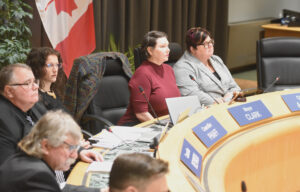
More than 60 residents holding signs against the new Saamis Solar Project were in the gallery on Monday during a city council meeting at city hall. Still, councillors unanimously approved a budget amendment of $131.5 million to move forward with a 75-megawatt portion of the Saamis Solar Project, saying the business case makes good financial sense for the community's future.--NEWS PHOTO BRENDAN MILLER
bmiller@medicinehatnews.com
City councillors on Monday unanimously approved moving forward with a $131.5-million, 75-megawatt phase of the Saamis Solar Project, subject to a sale contract and to the disapproval of approximately 60 members of the public sitting in the gallery.
The controversial project has been debated among council for several years and was a major issue heading into the October municipal election as the city announced a conditional deal to acquire the array from DP Energy last August, shortly after the project was approved by the Alberta Utilities Commission, and would be built to export power onto the provincial grid.
Back in 2023 councillors approved $7 million toward the purchase and supported the production of the solar energy production to offset compliance costs on city generated gas-fired electric generation.
Administrators have said the project is an economic way to shield the city from rising carbon levels and lower cost production, and to gain control of the project to scale its limits to the growing needs of future eclectic demands.
However, opponents claim the economics of renewable energy is unstable and say they have conducted third-party research on solar power and all the associated costs that could potentially come with the project.
One group, the Medicine Hat Utility Ratepayers Association, has been seeking more communication between citizens and elected officials to allow councillors to hear different opinions from residents.
Following a lengthy presentation to council from Rochelle Pancoast, managing director of energy, land and environment, councillors discussed the purchase of the project before voting in favour to move forward.
City staff ensured councillors that property taxes or utility rates will not be impacted by the purchase, as the majority of funding comes from the city’s Energy Transition Reserves, while the remaining amount will be funded by debt financing.
Staffers also reassured council that Medicine Hat is in the energy making business and that timelines to receive roughly 30 per cent funding from Ottawa are expiring and they do expect the project to make the city money in the long run. The sentiment was echoed among council.
Coun. Chris Hellman attempted to dispel rumours circulating on social media to those present on Monday, many of whom were holding “No Solar” or “No Saamis” signs, making a visible statement during the meeting.
“Economic development, we need growth, and this checks a big box there,” Hellman said toward the gallery. “So, as you heard in the presentation, there is a green customer out there that is in search of that kind of electricity that we don’t have to offer. If we don’t make that available in our community we are going to lose that opportunity.
“I heard some chuckles in the gallery about property taxes, it won’t raise your property taxes, in fact it might do the opposite,” Hellman said, citing an additional $1.5 million annually that would be generated by the property tax of the project.
Hellman also provided clarification around funding of the project.
“This Energy Transition Reserve fund is specially for this. This is not something we can use to offset property taxes, it’s not something we can build swimming pools with, it’s not something like that. It either gets used for something like this or it doesn’t. So this money has been saved for a very long time for a project like this and that’s what we are utilizing.”
Coun. Dan Reynish asked city staff why they cannot release more business details around the project and was told those details are critical for negotiations and cannot be shared publicly.
“We need to be highly respectful if they have asks to keep things confidential, it also means that we need to find a way to work together to find a win-win,” said Pancoast. “If we share all our information with the public today, we no longer have any room to find win-win.”
Coun. Ted Clugston asked members of the public to put down their “No solar” signs while he read part of the motion, however those in attendance defied the ask and raised their signs higher in the air.
Eventually emotions took over and unruly members of the crowd began yelling at council members, forcing a brief recess break.
Following the break, Coun. Stuart Young delivered a passionate speech aimed at members of the gallery.
“I want to have a good conversation here, I really do. I want to get into the details but if people aren’t going to listen or give any resemblance of respect… ” he stated loudly. “Everyone is telling us we have to respect them and I understand that we do have to respect them, but it goes both ways.”
Young stated his decision to support the project was based on the facts he has been presented as an elected official and believes the project will make the city money in the long run.
City staff reiterated that Medicine Hat has been in the energy business for more than 100 years and it has served the community well financially.
Mayor Linnsie Clark says that without energy production, the city could not afford the luxuries Medicine Hat has today.
“We have here an opportunity for not just energy sale revenue but for economic development, potentially tax revenue … potential for jobs, potential for cluster development, for getting the ball rolling on new investment in the city,” said Clark. “Regardless of what generates the electrons, we sell the electrons, that’s one of the things that we do and we make good money from it, and our residents benefit by having lower taxes than they otherwise would, and competitive rates.”
The initial 75 MW phase is planned on the northwest area of the approved project land, however the total footprint of the purposed expanded 325 MW project is 2,270 acres north of Parkview Drive.
The city will now seek to amend the AUC’s siting permit and related transmission needs from the initial 325 MW to the smaller 75 MW size. City staff will also need to secure an Energy Sales Agreement with one or more counterparts.
The city expects the project to be operational in 2028.