It’s Old News: U.S. President Harry Truman supports hydrogen bomb development
By MEDICINE HAT NEWS on January 29, 2026.
News Archives
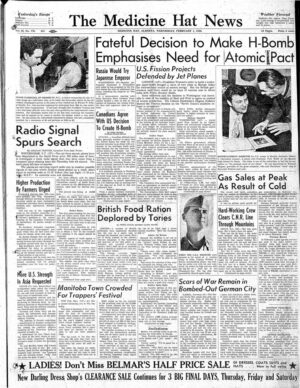
Harry Truman accelerated the United States’ pace in the nuclear arms race this week in history.
The 33rd president of the United States publicly announced his support for the development of a hydrogen bomb on Jan. 31, 1950. The announcement came five months after the Soviet Union’s atomic bomb project progressed to a test, detonating their first bomb August 29, 1949.
Truman told The Associated Press he reached his conclusion under his, “responsibility as commander-in-chief of the armed forces to see it that (the U.S.) is able to defend itself against any possible aggressor.”
His decision was greeted with approval in congress, where it had been advertised as a defence measure.
“I believe the bomb’s potential destructive power will bring the people of the world to their senses, to the end that we will have world peace.”
The News is looking back at notable events from Medicine Hat and the world’s history as we enter our 141st publishing year.
In Canada, officials generally agreed the U.S. made the, “momentous decision to go ahead with the production of the hydrogen bomb…”
UN diplomats speculated the H-bomb announcement could impel the Russians to re-enter talks on control of the atom and weapons of mass destruction.
The Feb. 1, 1950 News says scientists estimated the prospective new weapon to be many times more powerful than the atomic bombs that rely on uranium. Some said the explosion from the H-bomb would be up to 1,000 times as great as that of the uranium bombs.
The U.S. executed its first U.S. H-bomb tests on Nov. 1, 1952, not announced by Truman until Jan. 7, 1953.
Ivy Mike was the codename given to the first full-scale test of a staged fusion device on the island of Elugelab in Enewetak Atoll, in the now independent island nation of the Marshall Islands.
The United States’ testing set off a new, more dangerous arms race between Western and Eastern powers.
The first Slokia design test, by the Soviet Union, was detonated in 1953. The Soviet’s first test of a ‘true’ hydrogen bomb came Nov. 22, 1955. Six years later, they detonated the largest, most powerful thermonuclear weapon, a three-stage hydrogen bomb with a yield of 50 megatons – a force equivalent to 10 times the amount of all the explosives used in World War II combined.
The bomb was capable of close to 100 megatons but was deducted before the launch.
A hydrogen bomb has never been used in combat. The atomic bombings of Hiroshima and Nagasaki in 1945, killing 150,000 to 246,000 people, most of whom were civilians, remain the only uses of nuclear weapons in an armed conflict.
Christopher Nolan’s 2023 film, Oppenheimer, followed the life of J. Robert Oppenheimer, the American theoretical physicist who helped develop the first nuclear weapons during World War II.
Oppenheimer, called the “father of the atomic bomb,” argued against work on the hydrogen bomb due to both lack of need and the enormous human casualties that would result from its use.
18
-17