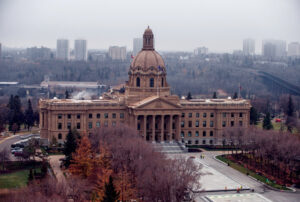
The Alberta Legislature is seen in Edmonton in this October 2024 file photo.--CP FILE PHOTO
zmason@medicinehatnews.com
The fall sitting of the Alberta legislature wrapped Thursday, marking the end of an historic session.
The fall session saw the UCP government invoke the notwithstanding clause four times, the most the constitutional loophole has been used in one sitting in Canadian history. The province had only passed legislation including the clause once prior to this sitting.
The clause was used for the first time this session to order Alberta teachers back to work following a three-week province-wide strike. It was used three additional times to shield laws in Bill 9 concerning names and pronouns, sports and gender-affirming care for transgender youth against legal challenges.
Cypress-Medicine Hat MLA Justin Wright says he stands by his government’s use of the notwithstanding clause on Bill 9, which he says protects girls in sport and prevents children from making adult decisions before they’re ready.
“I understand and I certainly sympathize with the concerns, but I certainly believe that we made the right choice on that one,” he said. “It’s not going to be well liked by folks that are impacted in that community, and I can respect and understand that.”
He was less certain about the use of the clause to pass Bill 2, the Back to School Act.
“I hear the criticism. I understand the criticism,” he said in an interview with the News on Friday. “I raised a number of concerns myself, and certainly when things were brought in line … it was the choice that was made, and I said I hope we end up being right on that.”
The government passed a total of 14 pieces of legislation and brought forward two motions over the course of the session.
Wright believes the No. 1 achievement of the session was the memorandum of understanding signed between the province and the federal government.
“It’s got some pretty big implications for us here locally, specifically around the immediate suspension and carve out of the Clean Energy regulations, which ultimately would have long-lasting impacts on our Medicine Hat advantage of owning our own utilities,” he said.
Wright says commitments made in the MOU, including the elimination of the federal emissions cap, will enable new investments in natural gas in the area that may otherwise have been deterred by federal policy.
Wright says other policy passed this session will deliver positive results for Medicine Hat, including Motion 17, which articulates the province’s refusal to participate in the federal firearms buyback program.
Wright also chaired the Water Advisory Committee that introduced Bill 7, the Water Amendment Act.
The Water Act had not been substantially updated since 1999. Wright says Bill 7 introduced changes regarding how water can be allocated in the future and what water management will look like that were meaningfully shaped by engagements with local farmers and stakeholders.
A number of bills passed this session legislated major changes to key public services like health care and the statutes governing elections and regulated professionals.
Changes to the province’s health-care system included the announcement of private diagnostic testing, the introduction of a dual-practice model for certain physicians, overhaul of the disability benefit and restrictions on gender-affirming health care for children under 16.
Other legislation reshaped requirements for running for election, registering political parties, or filing petitions, and prohibited DEI requirements and public expression rules for regulated professionals like doctors, lawyers and teachers.
Government also voted down a proposed increase to minimum wage.
The fall sitting saw the government, and particularly the health-care ministries, come under fire for poor planning, inadequate transparency and even corruption.
Reports were released by the Information and Privacy Commissioner, the Auditor General and a Manitoba judge hired to perform an independent review. The reports criticized policies and procedures that put Albertans’ privacy at risk, obscured performance data and enabled conflicts of interest.
Opposition members criticized the government for invoking legislation on several bills to limit debate and pass bills faster. Time allocation motions were introduced to expedite the passing of some of the session’s most controversial bills, including Bill 9 and Bill 11.
House leader Joseph Schow says the legislation passed this session has made Alberta the best place to invest and do business.
“Through a robust legislative agenda, our government has successfully delivered on keeping Alberta the best place to live, work and play,” he said. “I, along with my colleagues, are proud to stand in defence of Albertans, our economy and their well-being.”
The Alberta Federation of Labour, a worker advocacy group representing 170,000 Albertans, said it found numerous bills passed this session were highly objectionable.
“The UCP government under Premier Smith has used the Alberta legislature as an anti-democracy sledgehammer in this session,” said AFL president Gil McGowan.
Opposition leader Naheed Nenshi called the session agenda shameful and out of touch.
“Albertans are clear about what they want from their government: help with rising costs, better health care, a properly funded education system, good jobs and an ethical government,” said Nenshi.”The UCP spent the fall session delivering on none of those things.”
Wright says he expects the tone of the spring session to be different.
“I think it’s going to be a much lighter touch,” he said.
He says his focus will shift from policy to advocacy as he aims to promote capital programs in southeast Alberta. High-level projects he says he’ll prioritize in the spring include bringing back a maternity clinic, securing funding for the twinning of Highway 3 and investing in expansion at Medicine Hat College.
Bills passed in the fall sitting, 2025:
– Bill 1: International Agreements Act
– Bill 2: Back to School Act
– Bill 3: Private Vocational Training Amendment Act, 2025
– Bill 4: Public Safety and Emergency Services Statutes Amendment Act, 2025 (No. 2)
– Bill 5: Miscellaneous Statutes Amendment Act, 2025
– Bill 6: Education (Prioritizing Literacy and Numeracy) Amendment Act, 2025 (No. 2)
– Bill 7: Water Amendment Act, 2025
– Bill 8: Utilities Statutes Amendment Act, 2025
– Bill 9: Protecting Alberta’s Children Statutes Amendment Act, 2025
– Bill 10: Red Tape Reduction Statutes Amendment Act, 2025 (No. 2)
– Bill 11: Health Statutes Amendment Act, 2025 (No. 2)
– Bill 12: Financial Statutes Amendment Act, 2025 (No. 2)
– Bill 13: Regulated Professions Neutrality Act
– Bill 14: Justice Statutes Amendment Act, 2025