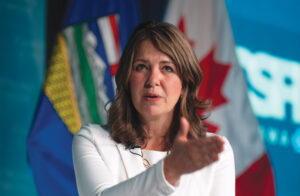
Premier Danielle Smith and Justice Minister Mickey Amery introduced a bill last week stripping professional regulatory bodies of specific oversight of their own professionals. They say the bill will protect free expression for regulated professionals, but critics say it's a governmental overstep.--CP FILE PHOTO
zmason@medicinehatnews.com
On Nov. 20, six provincial Ministries introduced Bill 13. If passed, the Regulated Professions Neutrality Act will alter the ability of regulatory bodies and colleges to sanction members, assign mandatory trainings, or use affirmative action to pursue workplace diversity, equity and inclusion.
“Every Albertan must be able to express their opinions and beliefs freely without fear of losing their job or being punished,” Mickey Amery, Minister of Justice and Attorney General, said about the bill last week. “This legislation makes that protection real and holds professional regulatory bodies to a clear standard.”
“Professionals should never fear losing their licence or career because of a social media post, an interview, or a personal opinion expressed on their own time,” said Premier Danielle Smith.
“Alberta’s government is restoring fairness and neutrality so regulators focus on competence and ethics, not policing beliefs. Every Albertan has the right to speak freely without ideological enforcement or intimidation, and this legislation makes that protection real.”
Bill 13 would apply to all regulated professions in Alberta, including doctors, lawyers, engineers, teachers and more than 100 other regulated professions.
In addition to preventing regulators from disciplining professionals for views expressed off duty, Bill 13 would prevent regulators from mandating diversity, equity and inclusion education or training.
The bill would amend existing laws that govern regulated professionals.
Off-duty expressions can still be disciplined for certain kinds of statements, including those that involve threats of physical violence, misconduct involving professional boundaries or sexual misconduct.
Jon Rossall, senior counsel at the Edmonton-based law firm McLennan Ross, says he sees the bill as an attack on the independence of regulated professions in the province.
“What I’ve seen over the last decade or so is a movement towards government intervention in these regulations to make it less independent and more government controlled, and I see this as another step in that same direction,” he said in an interview with the News.
Rossall says defining misinformation is a grey area that regulatory bodies are already contending with.
“In the medical or legal professions, there’s all sorts of differences of opinion,” he said.
Rossall says many professionals have a unique credibility when making public statements that require responsible consideration. Distinguishing what is a professional opinion from what is the personal opinion of a person in a given profession is an ongoing challenge.
But he says the line is clearly crossed when a professional expresses a view that the overwhelming majority of their profession would agree is inappropriate or inaccurate.
“These are the examples that, unfortunately, I think our UCP government might be focused on a bit, classic examples during COVID.”
During COVID, medical professionals would be investigated by their regulatory bodies for using their platform to make claims that diverged from the consensus of the medical community.
“This legislation might have the effect of preventing that kind of sanctioning, and that concerns me a little bit,” said Rossall. “Our government is placing the so-called right of free speech above the responsibility to be appropriate and responsible in your professional ethics.”
Sean McEwen is a workplace equity, diversity, inclusion and culture consultant. For 26 years, he has designed and overseen employment inclusion services for groups underrepresented in employment in Alberta.
He says he doesn’t understand the logic behind the bill.
“My big comment to anyone that isn’t a fan of things like workplace equity, diversity and inclusion is those aren’t things that people are doing just on the basis of social justice. They’re also economically the most viable strategy,” he told the News.
McEwen says a quarter of Canada’s workforce is projected to age out by the year 2035.
“If we can’t effectively engage, recruit and retain people from other cultures, we’re not going to be able to maintain our workforce,” he said. “When people are feeling like they’re not welcomed in a work environment, they leave. The costs of staff turnover are huge for employers, so taking the time to have a more equitable and inclusive workplace culture is something that serves everyone in that culture.”
The bill prohibits the ordering of any training relating to unconscious bias or cultural competency. It also precludes “preferential treatment to achieve diversity, equity and inclusion” based on factors like race, sex and national origin.
McEwen says it’s important to understand how many people fall into one or more of those categories.
“We’re not talking about a minority of people. We’re actually talking about a majority of people at this point.”
McEwen says the failure to create workplaces where people of all backgrounds feel safe also has real effects on a worker’s productivity and their health.
He doesn’t hold back in his opinions about the bill.
“I think it’s transparently political ideology manifesting as policy.”
Lawyer suggests Peterson wouldn’t have been saved by so-called ‘Peterson law’
Smith cited Jordan Peterson’s disciplining from the College of Psychologists of Ontario as an example of the type of action by a regulatory body the bill is intended to prevent.
The complaints that prompted the college’s action were in reference to public statements Peterson made regarding COVID-19, climate change, the actor Elliot Page and the existence of white supremacy in Canada.
The college deemed Peterson’s comments “degrading” and sanctioned him. It also ordered Peterson to participate in social media training.
Rossall says he finds the bill’s namesake ironic. Having reviewed the Peterson decisions himself, both at the college and the court levels, he believes the investigations would still have proceeded.
“I personally believe that, even were this legislation in place in Ontario when the Peterson investigations occurred, I’m not sure it would have made a whole bunch of difference.
“I just don’t think it’s necessary.”