‘Project Hail Mary’ adds to a winning streak for originality at the movies
By Canadian Press on March 24, 2026.
NEW YORK (AP) — Franchise movies have been the dominant currency in Hollywood for years, but, lately, the upside of originality has been hard to miss.
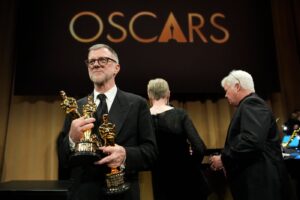
A week after “One Battle After Another,” “Sinners” and “KPop Demon Hunters” all
triumphed at the Academy Awards, Phil Lord and Chris Miller’s
“Project Hail Mary” notched the
biggest non-franchise opening weekend since “Oppenheimer.” In the first three months of 2026, the two biggest hits in theaters are it and the Pixar original
“Hoppers.”
All of these successes came at considerable expense. “Project Hail Mary,” based on the Andy Weir bestseller, cost close to $200 million to make. But its $80.5 million debut vindicated Amazon MGM’s big bet, and gave the studio its largest box-office hit yet.
“They made a tremendous investment and it’s going to pay off,” Lord said in an interview alongside Miller last week. “How exciting to reward the people that took a shot.”
“Project Hail Mary,” despite its title, isn’t anyone’s idea of a long shot. It stars one of the most widely liked actors in Ryan Gosling. Its source material, Weir’s novel, is beloved. And it trades on much of the same science-first sci-fi appeal of 2015’s best picture-nominated “The Martian,” from an earlier book by Weir. Lord and Miller, the filmmakers of
the “Spider-Verse” movies and “The Lego Movie,” have a long track record of success with both audiences and critics.
But the recent run for originality — at the Oscars and the multiplex — suggests audiences may be more eager for something different from the same old. At the least, the potentially cascading rewards of an original hit are freshly apparent at a time when a lot of big bets — like the $130 million-plus that Paul Thomas Anderson’s best picture winner “One Battle After Another” cost Warner Bros. to make — have paid off so massively.
“People go to the movies to see a new experience,” Miller said. “They don’t go to see a thing they’ve already seen. Originality has value, especially as AI gets into the picture. The value that we can bring as filmmakers is to bring something that can’t be AI because it hasn’t been thought of before.
“So it’s good business.”
Franchise domination
Franchises have hardly been displaced. They will, no doubt, largely control the box office for the rest of year, beginning with Universal’s “The Super Mario Galaxy Movie” next month, followed by anticipated releases like “Toy Story 5,” “Avengers: Doomsday” and “Dune: Part Three.” Last week, the 11th “Spider-Man” movie this century, Sony Pictures’ “Spider-Man: Brand New Day,” set a new trailer record with 718.6 million views in its first 24 hours.
So, yes, franchises still very much rule the day. But waves upon waves of sequels, reboots and remakes have made the few big-budget originals that manage to get made all the more singular.
“If we don’t continue to do originals, we’re going to run out of stuff,” Pete Docter, Pixar chief creative officer, earlier told The Los Angeles Times.
Since its founding, Pixar has clung to a belief that original movies are part of its mission, though that quest has grown more arduous in recent years. During the pandemic, “Soul,” “Luca” and “Turning Red” were diverted to Disney+. “Elemental” seemed like a disappointment at first but it just needed time to catch hold, eventually collecting $496 million.
“Hoppers,” directed by Daniel Chong, is hoping to follow that trajectory. So far, in three weeks of release, it’s grossed $242.6 million worldwide for The Walt Disney Co. — good business, to be sure, but a far cry from the pace of the 2024 blockbuster sequel “Inside Out 2.” It grossed $1.7 billion.
Such economics are tough for original movies to compete with, plus non-franchise films take more effort, and money, to market. For a $200 million movie, marketing costs can come to nearly rival production budgets.
Though some of
Timothée Chalamet’s showmanship, complete with a blimp and a trip to the Sphere,
might have cost him an Oscar, his promotional efforts were surely necessary to help lift
“Marty Supreme,” A24’s most expensive movie ever — with a budget of $70 million — to $179.3 million in ticket sales.
An ambitious marketing campaign also accompanied “Project Hail Mary.” Gosling was everywhere from hosting “Saturday Night Live” to
doing the “La La Land” dance with his alien co-star, Rocky. But the movie always rested on the appeal of the comic sensibilities of its filmmakers, Weir’s book and Gosling.
“We’re all united by the fact that we’ve spent the last two decades having people ask us: What genre is this?” says Drew Goddard, who scripted both “The Martian” and “Project Hail Mary.” “We’re constantly hard to classify because we love existing in those strange places. We like drama, we like comedy. We like heartbreak, we like terror. We like silliness.”
Streaming economics change the calculus
In matching broad-appeal material with the right filmmakers and stars, “Project Hail Mary” relied on not just old-school studio moviemaking but
the sometimes overlooked lessons of “Barbenheimer.” Both Christopher Nolan’s “Oppenheimer” and Greta Gerwig’s “Barbie” showed what can happen when the right filmmakers are given free rein on a big canvas. There is a definite downside, though. Warner Bros.’
“The Bride!” by Maggie Gyllenhaal seemed like a compelling, filmmaker-driven concept but its losses might approach $100 million.
Aside from having Gosling in common, “Project Hail Mary” also shared the producer of “Barbie” in Amy Pascal. Before the studio’s acquisition by Amazon, it was greenlit by then-MGM chiefs Mike De Luca and Pam Abdy. They later moved on to Warner Bros., where they made both “One Battle After Another” and Ryan Coogler’s much-celebrated “Sinners” ($370 million in ticket sales against a budget of $90 million).
As much as Amazon’s $8.5 billion purchase of MGM was motivated by capturing some of the richest IP in movies, James Bond, it’s also true that studios can establish themselves with homegrown hits. The opening for “Project Hail Mary” was Amazon MGM’s biggest ever.
In fact, three of the biggest original hits of the past year have come from streaming companies: Apple with
“F1,” Netflix with
“KPop Demon Hunters” and Amazon with “Project Hail Mary.” For these studios, box-office performance is only part of the win; Netflix didn’t even publicly record the chart-topping theatrical weekend of “KPop Demon Hunters.”
These companies are sometimes willing to take greater risks because breaking even in theatrical isn’t the end-all-be-all goal. Driving attention to their streaming platforms is just as vital. “KPop” was developed and produced by Sony Pictures, but, sensing the potentially perilous road to opening it theatrically, the company sold it to Netflix. There, it became the streamer’s most-watched movie ever.
“It shouldn’t be lost on anyone that three of the biggest original hits over the past year have come from the biggest streamers: Netflix, Amazon and Apple,” says Paul Dergarabedian, head of marketplace trends for Comscore. “What the streamers are finding is that they can parlay their small-screen successes into the big screen, and vice versa.”
As much as franchises will soon take back the multiplex, a number of high-profile movies will try to continue the winning streak for original films, among them Steven Spielberg’s “Disclosure Day,” Alejandro G. Iñárritu’s “Digger,” J.J. Abrams’ “The Great Beyond” and, if you count one of world’s oldest stories, “The Odyssey,” by Nolan.
But even in the celebration for “Project Hail Mary,” the pull franchises exert on the movie business was implicit. Amazon MGM, in reporting the movie’s performance, included a nod to its marquee IP, 007, in the figures: $80,506,007 in 4,007 theaters.
Jake Coyle, The Associated Press
31
-30