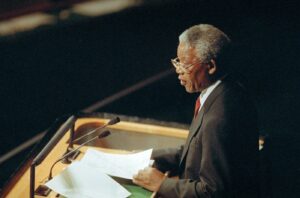
Antoine Fuqua’s ‘Troublemaker’ lets Nelson Mandela speak for himself
By Canadian Press on January 26, 2026.
PARK CITY, Utah (AP) —
Antoine Fuqua always knew
Nelson Mandela as an icon. But he had no idea he was such a rebel too, and a literal fighter. He remembered walking into a restaurant and seeing a picture of a man in a boxing stance and asked why they had a poster of
Muhammad Ali on the wall. They didn’t, he was told: It was Mandela.
It was just part of what would be an enlightening journey in making the new documentary, “Troublemaker,” which has its world premiere Tuesday at the
Sundance Film Festival.
“He evolved into the Mandela that we all know and love,” Fuqua said. “The troublemaker allows you to sort of see him not just a mythical character or as a global icon, but as a fallible human being, someone who became a great leader, who in the beginning was a rebel, if you will, and who was willing to engage in violence at some point, if necessary, for the greater good.”
The film uses Mandela’s own voice, drawn from over 70 hours of recordings to tell the story of the
struggle against apartheid. Fuqua collaborated closely with
Mac Maharaj, an anti-apartheid activist, who was imprisoned on Robben Island with Mandela and who played a key part in smuggling Mandela’s writings, which would become
“Long Walk to Freedom,” out of the prison
Fuqua, Maharaj and the filmmaking team traveled all around South Africa, visiting important locations in Mandela’s story, from the University of Fort Hare, where Mandela was a student before being expelled for protest activities, and
Robben Island, where he was imprisoned from 1964 to 1982, to Qunu, his final resting place.
He even slept a few nights on Robben Island, which he said was “very uncomfortable.” While there they got a feeling for where Mandela spent 18 of his 27 imprisoned years and bonded at night over dinners. That’s where Maharaj told him Mandela was a Tracy Chapman fan.
They met many people along the way, including some who were part of the resistance against apartheid, taking to heart their continued optimism and hope despite past and present grievances and racism.
“One gentleman came in and he had no arm, his eye was missing. He looked like a character out of James Bond. He had a Tommy Bahama shirt on, he had the hat on,” Fuqua said. “And he was so full of life and so funny and so matter of fact about what happened to him, fighting for justice. I started to learn so much more about the people there.”
The film, which Fuqua has been working on for over three years, blends archival footage and photographs, interviews with Maharaj and animation by South African artist Thabang Lehobye to fill in the gaps where footage didn’t exist, like on Robben Island.
Fuqua hopes the lessons audiences take are on a global scale.
“The lesson I learned was meaningful change is never easy or comfortable,” Fuqua said. “The people in the moment were willing to do what’s necessary, the difficult job to make change.”
He added: “I hope people take the lessons of great leaders like Mandela and Mac Maharaj … People who stood up for the right reasons.”
___
For more coverage of the 2026 Sundance Film Festival, visit:
https://apnews.com/hub/sundance-film-festival
Lindsey Bahr, The Associated Press
18
-17