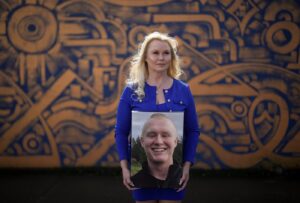
These are the faces of B.C.’s 10-year toxic drug emergency
By Canadian Press on April 9, 2026.
More than 18,000 people have died of drug overdoses since British Columbia declared the issue a public health emergency on April 14, 2016.
The crisis has touched the lives of many more survivors, and the friends and families of victims. Here are some of their stories.
‘HE HAD A TWINKLE IN HIS EYE’
When
Michelle Jansen learned her 20-year-old son, Brandon, had died from fentanyl poisoning at the treatment facility where he went for help, she said she knew she had to make a decision
“in a matter of seconds.”
She could sink into despair at losing the child she described as having a quick wit and a love of animals, or she could find a way to move forward with her two other sons.
“So I could either sink, which at the time is your preferred approach, you know? Or pick yourself up and fight and excel, and that was the decision, the latter, that I made because I knew my boys would be watching,” she said.
Brandon Jansen’s death at a drug treatment facility in Powell River, B.C., on March 7, 2016, came about five weeks before B.C. declared the public health emergency.
“He was very charismatic,” his mother said. “He had a twinkle in his eye. He was a communicator. He would come into a room. He wouldn’t necessarily know anyone and he would smile and be warm and congenial. At the treatment centres, all the feedback I got was he would take people under his wing.”
Michelle Jansen became a voice for those who had lost someone in the crisis, launching a foundation in her son’s name and speaking out against what she saw as government inaction.
A decade later, the frustration can still be heard in her voice.
“People are dying. If we had a gunman running around, killing five or six people a day on average, you better believe that the government’s going to put the money behind it to make sure that that stops, that we’re going to get that gunman,” she said.
But after years of fundraising, Jansen said the family decided to pause the foundation, adding that it was difficult to relive the situation.
“It’s only getting worse. It’s getting worse and nobody’s listening,” she said.
‘THEY SURROUND ME WITH LOVE’
Meredith Dan says her only son, Glenn Rebic, loved skateboarding and its community that he helped build in Vancouver. They now help keep her going, more than six years after his death at the age of 29.
Memorials at skate parks “all over the place” are one sign of the impact he had, she says.
“He definitely left an impact on this world because not one single day in six and a half years has gone by that I haven’t heard from somebody in his friend group,” she said.
“They surround me with love and so much support. The reason I’m still standing is because of them.”
On June 21, 2019, Rebic died after using cocaine that he didn’t realize had fentanyl in it.
Dan says she needed to learn as much about his death as she could. She obtained copies of the 911 calls, ambulance and police reports as well as copies of the autopsy report and coroner’s report.
She estimates she has had 100 therapy sessions since her son’s death.
“I was either going to end up on the Downtown Eastside myself, or I had to feel everything. I had to know everything,” she said.
She also filed a complaint against the officer who informed her of Rebic’s death, saying she had done so in a “hostile and aggressive” manner. Dan fought the case for years, and media reports said the officer was found to have committed misconduct.
“If anything from his death can help people, I know that he would be very proud because of that,” she said.
‘I KNOW HE TOUCHED PEOPLE’S LIVES’
Michael Rantanen was just shy of his 26th birthday when he died of drug poisoning on July 15, 2022.
His mother, Maria Rantanen, says her eldest son was an artist whose drawings and paintings were “descriptive of how he was feeling” and often included tears.
“I look back on pictures and memories and things that we did together. He had a life. It wasn’t like that defined his entire life,” she says.
She describes her son as a kind and empathetic person whose two favourite activities were art and skateboarding.
“I know he touched people’s lives. He was a very kind person and caring and I’m sure there are a lot of people who miss him and miss all these people (who have also died),” she says.
She says whenever she looks at B.C.’s monthly data on the number of people who have died, she’s reminded that each number represents families that have been devastated and a person who couldn’t fulfil their life the way they wanted to.
“I think there is a generation of young people who are going to look back and say, ‘Oh, my God, I lost so many people,'” she says.
‘HOW DO WE KEEP EACH OTHER ALIVE’
Lenae Silva has been using opioids for two decades. She has seen the impact of toxic drugs in Nanaimo, B.C., both before and after the province’s declaration of a public health emergency.
“Just death after death after death after death that really made it hard to even focus, on anything that wasn’t like self-care, or fear, or our own feelings,” she says.
“It was more like this wave of ‘how do we keep each other alive since no one else seems to be wanting to help us.'”
She says people who use drugs took steps to protect each other in ways that have since become common recommendations during the crisis.
They did their best to make sure people didn’t use alone and warned each other about bad batches long before a formal provincial alert system was in place.
“That
was about all we could really do for each other. You know, try and keep the dope as safe as possible,” she says.
She co-founded Open Heart Collaborative, an organization launched during the pandemic that ran an outreach program bringing doctors and nurses to those in need and providing things like safe syringes and smoking kits.
“These are my friends. I am a substance user, so these are people that I’ve known for years in some cases, and new faces,” she says.
‘THESE ABSURD POLICIES BLOCKED THE PATH”
Ellen Lin said she and her husband immigrated from China to Canada about 20 years ago as “hard-working, skilled immigrants,” and believed it was a country where children could grow up safely.
“Our family has never had any contact with drugs and has always firmly rejected them. We trusted that Canada was a country where children were protected and safe,” she said in an interview in Mandarin.
But now she blames her daughter’s death on authorities who she says promoted flawed and “absurd” drug policies.
Emmy Liu was just 14 when she died of a fentanyl overdose in bed at the family home in Surrey, B.C., on Jan. 30, 2025.
Lin remembered her “pure-hearted” daughter as a cheerful, energetic and kind girl who cared for others.
“She had a rich imagination and creative thinking. She loved painting and playing the flute, and showed unique talent in the arts and creative writing,” said Lin.
She read fantasy and adventure novels and excelled at sports. She skied and hiked and performed traditional lion dancing.
Lin said she tried all means to prevent dealers and bad friends from supplying Emmy with drugs. But she blamed the B.C. government’s decriminalization experiment for creating an “environment unsafe” for children. The three-year program that meant adult users were not arrested for possession of small amounts of drugs was officially terminated a year and a day after Emmy’s death
“As a mom who just lost my younger daughter, I think the policy is extremely ridiculous,” said Lin.
“When my child’s life was in danger, I explored all resources and methods to save her. I had been seeking help from the police, from counsellors, and the school board. But I felt helpless. These absurd policies blocked the path to save my child’s life.”
‘I DIDN’T DIE BUT THE BUSINESS SURE DID’
If you walk into Second Chance Cafe in Saanich, B.C., on a Monday or Friday, you may find Edwin Bergsson behind the counter, humming ’90s hits.
His colleagues describe him as a natural at the job, and you may never know he suffered a brain injury after overdosing on illicit drugs about five years ago.
At the time, he owned a music studio where he worked with local rappers. He said it took off, “built up really quickly” and he soon became overworked and stressed. He turned to drugs and one evening he overdosed, surviving thanks to a friend who found him.
“I did all the rehab and stuff from Victoria General Hospital, and the rehab was extensive, and I went from a vegetable to somewhat-functioning human,” he said.
Bergsson is now a casual music listener, but no longer has a studio. “That died with the man,” he joked in an interview. “Obviously I didn’t die, but the business for sure did.”
He says he’s one of the lucky ones who connected to the necessary supports to aid in his recovery. That includes working part time at the café, which allows brain injury survivors to get back into the workforce.
He has found a sense of community there.
“I feel like I can share my story and we can kind of see where, or help each other about where we’re at now, and how we got there,” he said.
‘THE MOST BEAUTIFUL HUMAN BEING IN THE WORLD’
March 24 would have been Jacob Wilson’s 29th birthday.
“But he is forever 24,” said his mother, Shirley Wilson.
Wilson said her son died on Nov. 11, 2021, after struggling with an addiction that began after being run over by a pickup truck in 2018, and sustaining a brain injury.
She thinks the system failed him after his accident and he turned to drugs to cope.
She said he called her from the hospital the day before he died and said “Don’t worry, Mom, it’s going to be fine, I love you.”
“And those are the last words he said to me,” she said. “I got a call the next day.”
His body was found in a hotel room in Abbotsford on a wellness check, she said.
Wilson describes her son as a curious person with a sense of humour that you might miss “if you weren’t paying attention.”
She said he wasn’t perfect and she has never hid the fact that he became an addict after his accident, but “98 per cent of the time, he was the most beautiful human being in the world and I had the privilege of being his mom.
“
She said she has made it her mission to help change policy to connect people affected by brain injuries with the help they need and to reduce stigma about addiction.
“Jacob’s life mattered,” she said.
“Jacob’s story, I hope, (shows that) the worst possible outcome is death if we don’t do something. I can’t emphasize that enough.
”
— With files by Ashley Joannou, Nono Shen and Brieanna Charlebois
This report by The Canadian Press was first published April 9, 2026.
The Canadian Press
79
-78