Takeaways for F1 meetings on rule changes after a big crash and Verstappen’s hint at retiring
By Canadian Press on March 30, 2026.
A huge crash which left Oliver Bearman limping. Overtaking that sometimes happens by accident. And four-time champion Max Verstappen
mulling retirement.
Calling off races in Bahrain and Saudi Arabia leaves
Formula 1 and the FIA with a month before the Miami Grand Prix to figure out which problems to focus on and what to do.
The FIA is using that time for “a number of meetings,” the sport’s governing body said after Sunday’s
Japanese Grand Prix, “to assess the operation of the new regulations and to determine whether any refinements are required.”
Here’s what they’re likely to discuss.
Bearman’s crash puts safety in focus
Long before Oliver Bearman bounced over the grass at Suzuka and slammed into the barrier before limping away with a bruised knee Sunday, drivers had been warning this could happen.
Bearman was deploying extra electrical power to try to overtake Franco Colapinto, creating a big difference in speed as Colapinto moved across in front of him. The young Haas driver was left to choose between slamming into Colapinto or the wall.
Bearman said the speed difference of around 50 kph (31 mph) was a “massive overspeed” and something “we’ve not seen in Formula 1 before.”
It’s been a concern for drivers since the new regulations were drawn up with a big role for electrical power boosts. Some drivers have voiced concern about what could happen at a street circuit with barriers close to the track.
The FIA specifically referred to “the contribution of high closing speeds in the accident” in its statement Sunday announcing meetings to review the rules.
Unintended overtaking
There are a lot more passing maneuvers this year as drivers deploy “overtake mode” for extra electrical power, then often get caught again by the car they’ve just passed. Sometimes, drivers are reporting overtakes they didn’t expect, or want.
Drivers don’t have full control of when the electrical power deploys, other than overtake mode. Most of it is determined by an algorithm that runs alongside the regular engine acceleration.
That can mean drivers get a shot of power when they don’t want it. At least three times so far, drivers have reported passing other cars when they didn’t plan to, such as in a situation where defending the place afterward would be difficult.
Champion Lando Norris has called for more control of the power, but the main rule tweak so far was to limit battery recharging in qualifying in Japan last week.
Verstappen’s future uncertain
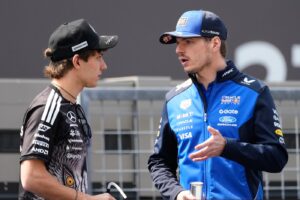
Four-time champion Verstappen has been the
loudest critic of the 2026 cars since preseason. Last week in Japan marked a big shift.
Verstappen said after qualifying he’d moved “beyond” being frustrated at the cars. The following day, he confirmed to BBC radio he’d consider retiring at the end of the season. “I keep telling myself every day to try and enjoy it. It’s just very hard,” he said.
The question now for F1 and the FIA is how much weight the four-time champion’s word should carry, especially when a star name like
Lewis Hamilton supports the new approach.
Mercedes domination
The first teenager ever to lead the F1 standings, 19-year-old Kimi Antonelli is a fitting face for F1’s new era after back-to-back wins in China and Japan. He and teammate George Russell have won all three Grand Prix races and the only sprint this year and taken every pole position.
The FIA has a new mandate to promote “competitive balance” in F1, so far largely untested, but Japan was a sign Mercedes’ dominance might not reach the level Verstappen and Red Bull managed in the past.
McLaren bounced back from technical issues as Oscar Piastri finished second and was challenging Antonelli early in the race, while Ferrari’s Charles Leclerc and Lewis Hamilton kept up a race-long fight with Russell, even if neither made the podium.
___
AP auto racing:
https://apnews.com/hub/auto-racing
James Ellingworth, The Associated Press
29
-28